
Core Web Vitals optimization – fixing LCP, INP and CLS on real sites
PageSpeed Insights shows a row of red numbers and it is hard to know where to start. That is a common starting point for Core Web Vitals optimization. This page explains what LCP, INP and CLS measure, how to read the numbers correctly and what usually causes each problem – and how UNANOBO handles the work as one clearly scoped service.
- Free demo – decide after you see it
- By message, in Japanese or English
- One person from demo to launch
FREE DEMO
Feel the faster version – free
Send us your current site address. We find what is dragging down your Core Web Vitals and show you the improved pages as a free demo.
- A clear diagnosis of LCP, INP and CLS
- Improved pages you can test on a phone
- A defined scope and plan for the fixes
What Core Web Vitals measure
Core Web Vitals are Google's page experience metrics. They put a number on three things: how fast the main content loads, how quickly the page responds to input and how stable the layout is. Core Web Vitals optimization means getting all three into the "good" range.
- LCP (Largest Contentful Paint): time until the largest image or text block appears. Good is 2.5 seconds or less; over 4 seconds is poor
- INP (Interaction to Next Paint): time from a tap or click until the screen responds. Good is 200 ms or less; over 500 ms is poor. It replaced FID in March 2024
- CLS (Cumulative Layout Shift): how much the layout jumps while loading. Good is 0.1 or less; over 0.25 is poor
Scores come from real visitors and are judged at the 75th percentile – three out of four visits must meet the threshold. That includes phones on slow connections, so a fast result on your office Wi-Fi is only part of the picture.
Reading PageSpeed Insights and spotting the warning signs
PageSpeed Insights shows two sets of data. The top block is field data from real users (the Chrome UX Report); that is what search uses. The lower block is a Lighthouse lab test for diagnosis. Its score is a guide and moves a few points every time you run it.
Low-traffic sites often have no field data at all. In that case, combine the lab results with the Core Web Vitals report in Search Console. These symptoms mean it is time to act:
- On a phone, the screen stays blank for seconds before the main photo appears
- Menus and buttons react a beat after you tap them
- Banners or ads push content down, so you tap the wrong thing
- Search Console lists more and more "poor" or "needs improvement" URLs
- Only the mobile result in PageSpeed Insights is far worse than desktop
Core Web Vitals are one ranking signal among many. The bigger payoff is fewer visitors leaving because the page is slow or jumpy. For speed across the whole site, see improving site speed.
Send your site address and we will map which metric fails and why, then show you the improved pages in a free demo.
Fixing LCP: get the first image and heading on screen fast
On small business sites, a slow LCP is usually the main hero image. Check which element PageSpeed Insights names as the LCP element and focus on delivering that one thing quickly.
- Lighter images: resize to the displayed size, export as WebP or AVIF, and serve smaller files to phones
- Loading priority: never lazy-load the LCP image; use fetchpriority="high" or preload where it helps
- Server response: on WordPress, set up caching, update old PHP and plugins, and add a CDN if needed
- Render-blocking files: remove unused CSS and JavaScript and cut down on web fonts
A home page slider rotating several large photos is a classic cause of slow LCP. Prioritizing only the first slide, or using a single still image, often makes a big difference on its own.
What the free demo gives you
- 01A working demoA demo site you can open and click through on a computer and a phone.
- 02A structure proposalWhich pages you need, what goes on each and where visitors get in touch.
- 03Plan and estimateAfter you have seen the demo you get the plan to launch and an estimate.
Why it is safe to ask
- The demo is free. If you decide not to go ahead, it costs you nothing.
- Everything happens by message, in Japanese or English.
- Your domain, hosting, ad and analytics accounts stay in your name.
- The founder handles your project from the first demo to growth after launch – one contact all the way.
Demo sites we built
 Dental clinic – ORATreatments, prices, doctors and booking
 Beauty salon – MIRTABooking form, price list and team
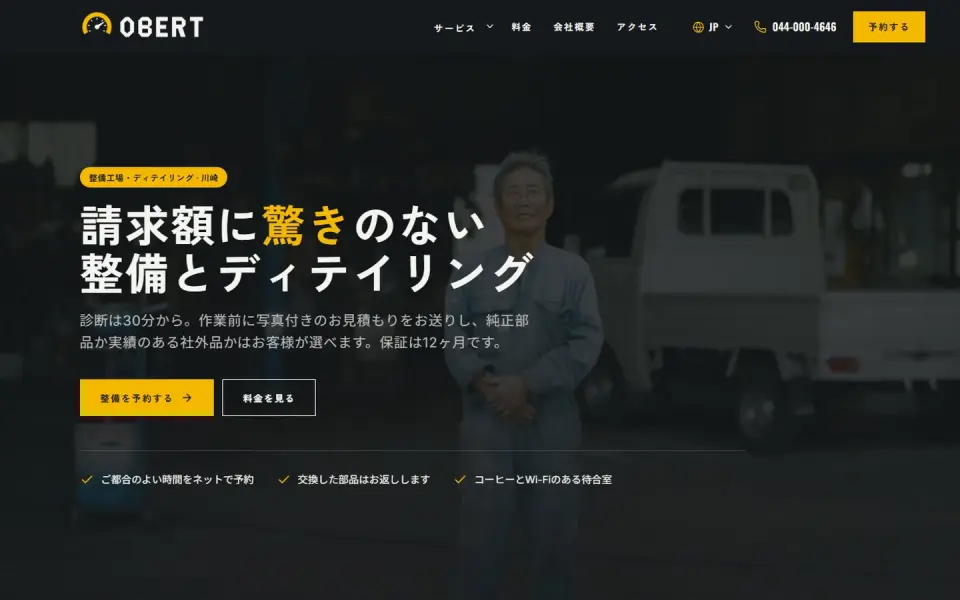 Car service – OBERTService and detailing prices, booking
Template demos with fictional brands. Yours is built with your own brand and content.
Fixing INP and CLS: faster responses and a stable layout
Poor INP almost always comes down to heavy JavaScript. Chat widgets, ad tags, analytics and social embeds pile up, and taps have to wait in line. CLS comes from images without set dimensions and elements that load in late.
- Tag audit: remove tags nobody uses from Google Tag Manager and the CMS, and delay the ones you keep
- Plugins and apps: unused WordPress plugins and Shopify apps often still add scripts to every page
- Media dimensions: set width and height or aspect-ratio so space is reserved before images load
- Space for late elements: reserve height for banners, cookie notices and embeds, or pin them to the bottom of the screen
- Web fonts: tune font-display and fallback fonts so text does not reflow when the font swaps
With Shopify, BASE and WordPress themes, the theme itself can be the problem. Knowing early whether settings will do or the theme needs replacing saves wasted work. For server setup, crawling and indexing, see technical SEO.
The free demo shows what can be fixed in settings and what needs rebuilding.
What to prepare before you hand over the work
Core Web Vitals work touches your admin panel and tracking setup. Having these ready speeds up diagnosis and fixes:
- Admin access to your site (WordPress, Shopify, BASE and so on) and hosting login
- View access to Search Console for the Core Web Vitals report
- Access to GA4 and Google Tag Manager, plus a list of the tags you rely on
- A note of features that must stay: booking forms, chat, ad conversion tracking
- The URLs that matter most: home, key service pages, top product pages
Field data covers the previous 28 days, so Search Console takes a few weeks to reflect a fix. Save PageSpeed Insights results before and after each change to compare them. If the mobile layout itself is the problem, start with making your website mobile-friendly.
How UNANOBO handles Core Web Vitals: a defined scope, fixed on your real site
Send us your site address and we go through PageSpeed Insights and the field data to pin down which metric is failing, on which pages and why. Then we build a free demo of the improved pages, so you can feel the difference on your own phone next to the current site.
At the demo stage you also get a clear view of whether theme adjustments are enough or a rebuild is faster, and we agree the scope before any work starts. The founder handles every project personally, from the first diagnosis to checking the numbers after launch, and everything runs by message in Japanese or English.
How it works
- 01
Free demo
We start with a free demo built around your brand.
- 02
Feedback
Structure, tone and details are refined with you, on the demo itself.
- 03
Launch
The site goes live on a solid SEO foundation.
- 04
Growth
SEO and ads take it further, guided by the numbers.
FAQ
What does the free demo show?
Working versions of your key pages with the LCP, INP and CLS causes removed. You can compare them with your current site on a phone and see the difference in speed and stability. The demo costs nothing.
Do I pay anything if I decide not to go ahead?
No. You can look at the demo and the diagnosis and stop there. The main causes we find are still useful if you fix them yourself or with your current developer.
Will better Core Web Vitals raise my rankings?
Core Web Vitals are one ranking factor, but content and competition weigh heavily too, so no specific position can be promised. The main goal is to keep visitors who would otherwise leave a slow or jumpy page.
How long does it take?
For a small site where image optimization and tag cleanup are enough, the work itself typically takes a few days to two weeks. Replacing a theme takes longer. Allow a few more weeks for Search Console to reflect the change.
Do you work with WordPress, Shopify and BASE?
Yes, all three. On WordPress the focus is usually caching and plugins, on Shopify theme and app scripts, and on BASE images and layout within what the theme allows. Each platform has different limits, so the demo stage makes the scope clear.
Can this run remotely, by message only?
Yes. With admin access, all work happens online. You get progress and before-and-after numbers by message, and replies within two business days, in Japanese or English.
Related pages
FREE DEMO
Try your faster site first
Send us your current site address and we will build a free demo of pages with LCP, INP and CLS fixed. Decide after you have seen the difference.