
Ecommerce website maintenance in Japan – updates, security and speed on a monthly plan
An online store needs steady care: checkout has to work every day, customer data has to stay safe and the shop has to look current. When you are busy listing products and shipping orders, app updates and speed checks are usually the first things to slip. This page covers what monthly maintenance includes, how to check security and page speed, and how to pick a provider – and why UNANOBO starts by showing you a free demo of your improved store.
- Free demo – decide after you see it
- By message, in Japanese or English
- One person from demo to launch
FREE DEMO
See your improved store – free
Send us your online store address. We build a free demo of pages improved for speed and easy buying, plus a proposal for the monthly maintenance tasks.
- Improved pages built from your current store
- Check speed and buying flow on a phone
- A proposal for your monthly maintenance
What ecommerce website maintenance covers each month
Store maintenance comes down to three jobs: keep it running, keep it safe and keep it fresh. Agreeing on which tasks are part of the monthly plan makes it clear what you are paying for.
- Function checks: test cart, checkout, account sign-up and contact forms on a schedule
- Updates: review and apply updates to WordPress, WooCommerce and plugins, or to Shopify themes and apps
- Security: clean up admin accounts, enforce two-step login, run backups, watch for unusual logins
- Speed: check image sizes, unused apps and scripts, and mobile load times
- Store updates: swap banners, build campaign pages, post shipping or holiday notices
- Monthly report: a short note on what was done, what looks risky and what to improve next
On hosted platforms such as Shopify and BASE, the provider looks after servers and the core cart. Maintenance there focuses on the theme, apps, speed and the shop front. On self-hosted setups such as WooCommerce, core and plugin updates and reliable backups are a central part of the work.
What happens when maintenance slips
Store problems rarely announce themselves. If any of these sound familiar, it is time to put maintenance on a regular footing.
- Update notices for apps or plugins keep piling up and nobody knows what is installed
- Product pages take a long time to show images on a phone
- Former staff or an old agency still have accounts in your admin panel
- You want new banners before a sale, with nobody available to make them in time
- Payment or shipping settings changed and nobody placed a test order afterward
- Years of theme edits mean nobody knows which change might break the layout
None of these is a crisis on its own, but together they quietly cost sales. Start by listing the current state of the store and sorting items into urgent fixes and work for the monthly plan.
Send us your store URL and we will show you improved pages in a free demo, with the fixes we would do first.
Ecommerce security checklist
An online store handles names, addresses and payment-related data, so security is one of the highest priorities in maintenance. Whatever platform you use, check these points regularly.
- Accounts: give each person their own admin account and remove unneeded accounts and permissions
- Login: turn on two-step verification for every admin and avoid reused passwords
- Apps and plugins: delete what you do not use and replace anything its developer no longer updates
- Backups: on self-hosted stores, run automatic backups and test that a restore works
- Card data: use a payment method that keeps card numbers off your own systems, and confirm 3-D Secure is on
- SSL and domain: know the renewal dates, the registered owner and the payment method
Merchants in Japan that accept credit cards are expected to follow the Credit Card Security Guidelines published by the card industry with the Ministry of Economy, Trade and Industry. The guidelines are revised from time to time, so check the latest version and any notices from your payment provider. For WordPress-based stores, our page on WordPress security goes into the details.
What the free demo gives you
- 01A working demoA demo site you can open and click through on a computer and a phone.
- 02A structure proposalWhich pages you need, what goes on each and where visitors get in touch.
- 03Plan and estimateAfter you have seen the demo you get the plan to launch and an estimate.
Why it is safe to ask
- The demo is free. If you decide not to go ahead, it costs you nothing.
- Everything happens by message, in Japanese or English.
- Your domain, hosting, ad and analytics accounts stay in your name.
- The founder handles your project from the first demo to growth after launch – one contact all the way.
Demo sites we built
 Café & roastery – KashtanMenu, events and an online bean shop
 Beauty salon – MIRTABooking form, price list and team
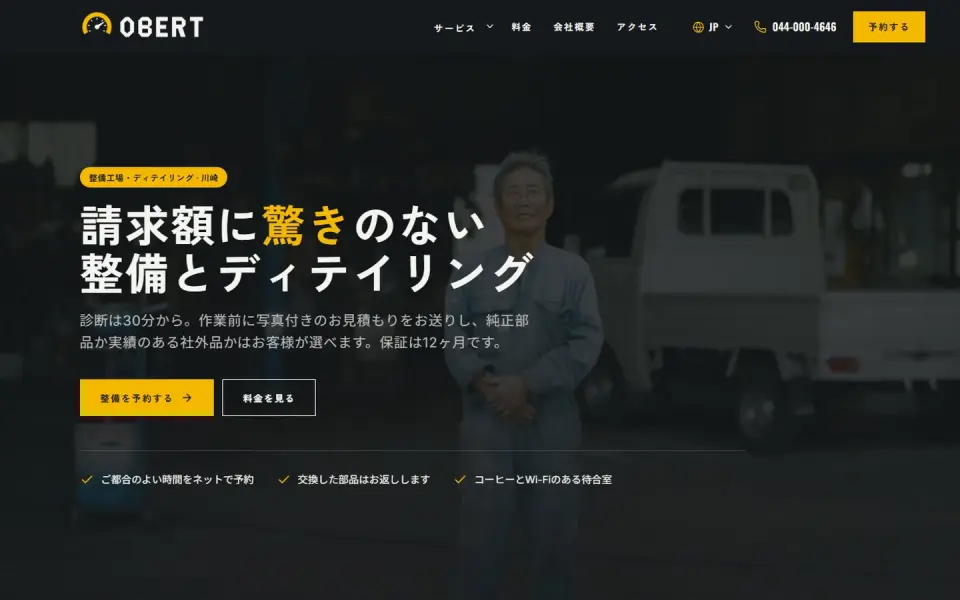 Car service – OBERTService and detailing prices, booking
Template demos with fictional brands. Yours is built with your own brand and content.
Page speed and updates: a monthly routine
Page speed affects how many visitors stay on a product page and move on to the cart. Stores tend to get slower as apps and images are added, so speed works best as part of a monthly check.
- Measure: test the home page, a collection page and a product page in PageSpeed Insights, focusing on mobile
- Images: resize oversized images, compress heavy photos and use light formats such as WebP
- Apps and tags: remove unused apps, duplicate tracking tags and old pop-ups
- Theme: review theme updates and test in a copy that your customizations carry over
- Shop front: clear out expired sale banners, long-sold-out items and old notices
- Test order: place a real order with your main payment and delivery options
In Shopify, duplicating the theme before editing lets you test changes without touching the live store. Record each check with the numbers and one line on what to fix next, and next month's work is already planned. If you also want help with product listings and promotions, see ecommerce operation outsourcing.
We rebuild a product page with lighter images and a clearer layout as a free demo you can try on your phone.
How to choose a maintenance provider and what to prepare
In Japan, monthly maintenance for an online store typically starts from around 10,000 yen for checks and small edits, and runs from several tens of thousands to over 100,000 yen when updates and improvement work are included. Compare what is done each month alongside the price.
- The monthly scope, and how extra work is handled, are written down
- The provider has hands-on experience with your platform: Shopify, BASE or WooCommerce
- There is a clear way to report problems and a stated reply time
- Admin, domain, payment and analytics accounts stay in your name
- Work is logged month by month, so it can be handed over
Before you ask for a quote, have ready your store URL, your platform and plan, a list of installed apps or plugins, and a few bullet points on what bothers you. If you run on Shopify and want day-to-day operation covered too, see Shopify maintenance and operation.
How UNANOBO handles store maintenance: a free demo first
Before any maintenance plan, UNANOBO builds a free demo based on your current store. Your home page and product pages are rebuilt with speed and mobile buying in mind, and you can click through them on a computer and a phone. Along with the demo you get the issues we spotted in your store and a proposal for the monthly maintenance tasks.
The process is simple: free demo, feedback, launch, growth. The founder handles every project personally, so you keep one contact from the first demo to ongoing maintenance and improvements. Everything runs by message, in Japanese or English, and you get a reply within two business days.
How it works
- 01
Free demo
We start with a free demo built around your brand.
- 02
Feedback
Structure, tone and details are refined with you, on the demo itself.
- 03
Launch
The site goes live on a solid SEO foundation.
- 04
Growth
SEO and ads take it further, guided by the numbers.
FAQ
Is the demo really free?
Yes. Send us your store URL and we build working versions of an improved home page and product page at no cost. The maintenance scope and estimate come after you have seen the demo.
What if I decide not to go ahead?
That is completely fine, and there is no charge. Feel free to use the issues we pointed out to improve your store on your own.
Do you work with Shopify, BASE and WooCommerce?
Yes, we support stores on Shopify, BASE and WordPress with WooCommerce. Each platform needs different checks, so we look at your plan and installed apps first and include only the tasks you actually need.
How long does the demo take?
It depends on the size of the store, but we can often show it within a few days to a week of receiving your URL and a short note on your goals. We reply to every inquiry within two business days and give you a time estimate then.
What do I need to prepare?
The store URL is enough to start. When maintenance begins, it helps to add a staff account for us in your admin panel and share a list of apps or plugins and your main concerns. There is no need to share your own password.
Can we work only by message, with no calls or meetings?
Yes. Everything runs by message in Japanese or English. For a small edit, a screenshot and one line of explanation is enough, and the written record makes it easy to review what was done.
Related pages
FREE DEMO
See your improved store first
Send us your store URL and we will build a free demo of improved pages, along with a proposal for monthly maintenance.