
Choosing a Shopify agency in Japan – test the fit with a free demo
There are many Shopify agencies in Japan, and labels like "Shopify Partner" and "Shopify Expert" make them hard to tell apart. This page explains what those labels mean and gives you a checklist for comparing agencies, typical costs and a list of what to prepare before asking for a quote. It also shows why UNANOBO builds a free demo of your store before you sign anything.
- Free demo – decide after you see it
- By message, in Japanese or English
- One person from demo to launch
FREE DEMO
See your Shopify store – free
Send your brand name and current site or social URL. We build a free demo of a Shopify store that fits your products and style, and you decide after seeing it.
- A store built around your brand, free
- Test product pages and cart on your phone
- A theme, app and launch plan proposal
Shopify Partner, Shopify Expert, "reseller": what the labels mean
When you look for a Shopify agency you will see several titles. Knowing what each one means makes agency websites and proposals much easier to read.
- Shopify Partner: any agency or freelancer registered in the Shopify Partner Program. Joining is free, and most people who build stores or apps for a living are members
- Shopify Expert: a name that comes from the former official "Shopify Experts" marketplace. Today it usually refers to businesses listed in Shopify's official Partner Directory
- Partner tiers: the Partner Directory shows levels such as Select, Plus and Premier, based on track record. Shopify revises the criteria from time to time
- Shopify reseller (代理店): a common nickname in Japan. Even when an agency builds your store, the Shopify subscription is a direct contract between Shopify and you as the store owner
Use the labels to build a shortlist, then judge each agency by the stores it has built and how specific its proposal is. Keep the Shopify account in your own name and give the agency collaborator access – that way you stay in control if you ever change partners.
A 7-point checklist for comparing Shopify agencies
Once you have quotes from two or three agencies, check these points alongside the price. They prevent most "this is not what we expected" moments after launch.
- Live stores you can open: go from a product page to the cart on your phone and judge speed and ease of buying yourself
- Theme and app approach: will they adapt an existing theme or build a custom one? Every extra app adds a monthly fee and can slow the store down
- What you can edit yourself: adding products, swapping banners and creating campaign pages from the admin panel
- Japanese commerce basics: delivery date and time slots, shipping rules, the Specified Commercial Transactions Act notice, and a sensible mix of card, convenience store and deferred payments
- Migration experience: if you are moving from BASE, Rakuten or WooCommerce, can they explain how products, customers and URL redirects are handled?
- After launch: who handles maintenance and improvements, through which contact, and will that person change midway?
- Account ownership: store, domain, GA4 and ad accounts all in your name
The first and last points matter most – check them before you sign. For the build process itself, see Shopify store development; for choosing between platforms as well as agencies, see how to choose an e-commerce agency.
Clicking through a real demo tells you more than any proposal. Send us your brand URL to start.
Typical Shopify costs and types of agency
The cost of a Shopify build depends on who builds it and how much is customized. As a rough market guide in Japan, a small store based on an existing theme typically costs a few hundred thousand yen, a store with custom design and features around 1–3 million yen, and large Shopify Plus projects can go higher.
- Large and mid-size agencies: dedicated teams for each role, strong on big projects and integrations with inventory or ERP systems; prices tend to be higher
- Small studios and freelancers: you talk directly to the person building your store; a good fit for small and mid-size shops. Confirm the scope and the after-launch support
- Building it in-house: the lowest build cost; plan for staff time to set up the theme, shipping, payments and legal pages
When comparing budgets, include the Shopify plan fee, paid theme and app subscriptions, payment fees and ongoing maintenance on top of the build. Plan prices and fees change, so check Shopify's official site for current numbers.
What the free demo gives you
- 01A working demoA demo site you can open and click through on a computer and a phone.
- 02A structure proposalWhich pages you need, what goes on each and where visitors get in touch.
- 03Plan and estimateAfter you have seen the demo you get the plan to launch and an estimate.
Why it is safe to ask
- The demo is free. If you decide not to go ahead, it costs you nothing.
- Everything happens by message, in Japanese or English.
- Your domain, hosting, ad and analytics accounts stay in your name.
- The founder handles your project from the first demo to growth after launch – one contact all the way.
Demo sites we built
 Café & roastery – KashtanMenu, events and an online bean shop
 Beauty salon – MIRTABooking form, price list and team
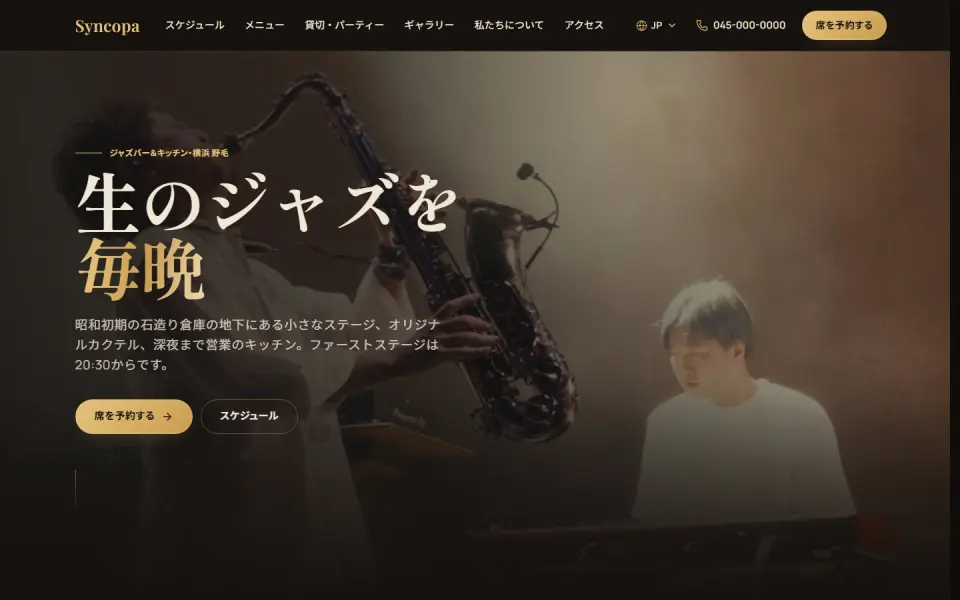 Jazz bar – SyncopaLive schedule, menu and table booking
Template demos with fictional brands. Yours is built with your own brand and content.
What to prepare before asking for a quote – and common mistakes
The more of this you have ready, the more specific the proposal and quote will be. A rough version is fine.
- Number and type of products, and whether they have variants such as size or color
- Logo, brand colors and the product photos you want to use
- Two or three stores you like, and what you like about them
- Shipping methods, how you want to charge shipping, preferred payment methods
- The URL of your current site or shop, if you are migrating
- Your target launch date and who will update the store
Typical mistakes: choosing a theme from its demo screenshots and finding it does not suit your own product photos; adding app after app until monthly fees pile up; migrating without URL redirects and losing search traffic. All of them are easier to avoid when the finished look and the day-to-day running are agreed before the contract. If you want help with updates and marketing after launch, see Shopify management services.
No final photos or copy yet? We build the free demo from the logo and information you already have.
A remote, bilingual studio: how UNANOBO builds Shopify stores
UNANOBO is a Web & Growth Studio for Japanese brands. When you ask about a Shopify store, we first build a free demo based on your logo, products and brand colors. You click through the home page and product pages on your computer and phone, and decide whether to go ahead once you like the direction.
The process is free demo, feedback, launch, growth. The founder handles every project personally, so you keep one contact from the first demo to marketing after launch. We work remotely from outside Japan, and everything runs by message in Japanese or English – useful if you are planning an English store or selling to customers abroad. If you are still comparing agencies, use the demo as one more piece of evidence.
How it works
- 01
Free demo
We start with a free demo built around your brand.
- 02
Feedback
Structure, tone and details are refined with you, on the demo itself.
- 03
Launch
The site goes live on a solid SEO foundation.
- 04
Growth
SEO and ads take it further, guided by the numbers.
FAQ
Is the demo really free?
Yes. We build a working demo of your store, centered on the home page, from your brand and products. After you have seen it, you receive a structure proposal, a plan and an estimate.
What if I decide not to go ahead?
That is fine – there is no cost at all. You are welcome to use the demo to compare us with other Shopify agencies.
Whose name is the Shopify account in?
Yours. You sign up with Shopify directly as the store owner, and we work through collaborator access or similar permissions. Your domain, GA4 and ad accounts also stay in your name.
How long does it take to launch?
It depends on the number of products and the amount of customization; a small theme-based store typically takes one to two months. We reply to every inquiry within two business days and explain the next steps for your demo.
What do I need to prepare to start?
Your brand name, the URL of your current site or social account, and an outline of your products are enough. A logo and product photos bring the demo closer to the real thing. We send a list of any missing materials later.
Can we really work only by message with someone outside Japan?
Yes. Everything is in writing, so it is easy to check and share with your colleagues. Write in Japanese or English, and feel free to send feedback as notes on screenshots.
Related pages
FREE DEMO
See your Shopify store before you choose
Send us your brand name and current site or social URL, and we will build a free demo of your Shopify store. Decide after you have seen it.