
Shopify API integration service – connect inventory, ERP, logistics and LINE
Fixing stock counts by hand after every order, emailing CSV files to the warehouse, keeping customer data in LINE and Shopify separately – a Shopify API integration removes this kind of manual work. This page covers what you can connect, how to tell whether an existing app is enough or custom development is needed, when headless makes sense and how to run the project safely. It also explains why UNANOBO starts with a free demo of your store and its integration plan.
- Free demo – decide after you see it
- By message, in Japanese or English
- One person from demo to launch
FREE DEMO
See your connected store – free
Send your store URL and the systems you want to connect (inventory, ERP, logistics, LINE). We build a free store demo and show an integration plan.
- A store demo built around your brand
- A clear split between apps and custom code
- An honest view on whether you need headless
What a Shopify API integration can do
A Shopify API integration uses Shopify's public APIs to exchange product, inventory, order and customer data with other systems automatically. Three tools do most of the work:
- Admin API: create products, update stock, read orders and customers – everything the admin panel does, from code. GraphQL is now the main version
- Webhooks: Shopify notifies your other systems the moment an order is placed or stock changes
- Storefront API: product display and cart features for screens outside the Shopify theme – the basis of a headless setup
Combined, they link your store with inventory software, an ERP, a warehouse system, accounting, LINE or in-store POS in one flow. Start by writing down the single manual task that costs you the most time – that is your first integration candidate.
Existing app or custom app development?
The Shopify App Store has many public apps for inventory sync, shipping and LINE. The first check is whether the system you want to connect already has one.
- A public app is enough when the other side offers an official Shopify connection – common for major inventory, order management and carrier services
- A custom app fits when you run an in-house ERP, have customer-specific prices or billing cycles, or use a product code scheme no app supports
- A mix works when apps cover most of the flow and a small integration script fills the gap
Custom Shopify development is usually built as a private custom app for your store only. Compare monthly app fees against development and maintenance over a few years, together with the hours saved, and the choice becomes much clearer. If your needs are mostly about theme and design, see Shopify customization.
Tell us how your workflow runs and we will show an integration plan alongside your free demo.
What to settle for each type of connection
Each integration partner brings its own questions. These are the points worth deciding at the design stage:
- Inventory and ERP: which system holds the master stock figure, how often it syncs (instantly or every few minutes), and a mapping of SKUs between systems
- Logistics and warehouse: when shipping orders go out, how tracking numbers return to Shopify to trigger the shipping email, and how cancellations or address changes are handled
- LINE: how a LINE user is matched to a Shopify customer, which events send a message (shipping, abandoned cart), and how consent is collected
- B2B sales: whether customer-specific prices, invoice payment and bulk orders come from Shopify's built-in features, an app or the API
We go deeper in LINE and e-commerce integration and B2B e-commerce. For any connection, a one-page diagram of who owns each piece of data and which way it flows keeps the spec stable later on.
What the free demo gives you
- 01A working demoA demo site you can open and click through on a computer and a phone.
- 02A structure proposalWhich pages you need, what goes on each and where visitors get in touch.
- 03Plan and estimateAfter you have seen the demo you get the plan to launch and an estimate.
Why it is safe to ask
- The demo is free. If you decide not to go ahead, it costs you nothing.
- Everything happens by message, in Japanese or English.
- Your domain, hosting, ad and analytics accounts stay in your name.
- The founder handles your project from the first demo to growth after launch – one contact all the way.
Demo sites we built
 Café & roastery – KashtanMenu, events and an online bean shop
 Beauty salon – MIRTABooking form, price list and team
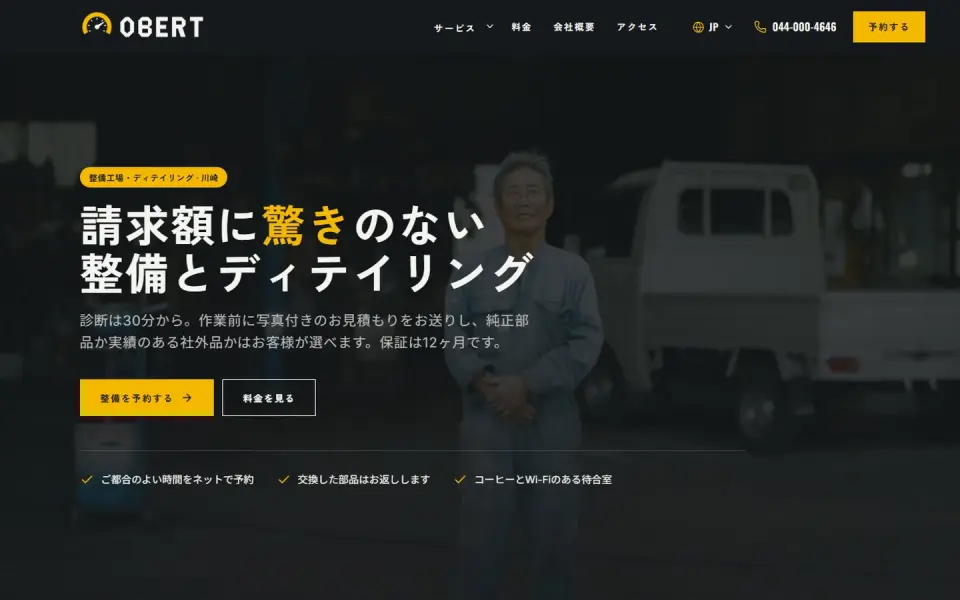 Car service – OBERTService and detailing prices, booking
Template demos with fictional brands. Yours is built with your own brand and content.
When Shopify headless is worth it
In a headless setup, Shopify keeps handling products, inventory and checkout, while the storefront customers see is built with a separate framework – Shopify's own Hydrogen, or Next.js and similar tools on top of the Storefront API. It makes sense when you:
- Want a brand site, editorial content and the shop in one experience that goes beyond what a theme allows
- Need the same products and stock on several screens, such as a mobile app or in-store displays
- Run multiple languages and regions and want fine control over speed and structure
Headless also raises the initial build cost, many theme apps stop working out of the box, and every update needs a developer. For a small catalog that you edit in-house, a customized theme plus API integrations is almost always enough. Consider headless once you can name concrete things your current theme cannot do.
See what a theme-based store can do in a free demo, then choose the setup.
How the project runs – and common pitfalls
A Shopify API integration usually goes: map the workflow, build a data mapping, test on a development store, switch over, then monitor. Most problems come from the preparation around the code.
- No decision on which system owns stock or prices, so both overwrite each other and the data drifts
- Bulk updates ignore API rate limits and stall during a sale
- Shopify releases a new API version every quarter and retires old ones, and nobody is assigned to keep the integration current
- Failed syncs send no alert, and missed orders go unnoticed for days
- Testing happens on the live store and touches real orders and stock
It helps to have ready: a short description of who does what in your current workflow, the other system's spec or a sample CSV, your product code list and its API terms. Run realistic test orders on a development store before going live.
How UNANOBO handles Shopify integration: a free demo first
Before you commit, UNANOBO builds a free demo of your Shopify store with your own brand and products. After hearing how your operations run, we also show an integration plan: which parts run on apps and which need a custom app. You decide whether to go ahead once both the store and the plan make sense to you.
The process is simple: free demo, feedback, launch, growth. The founder handles design, development and maintenance personally, so the person who knows your integration spec stays your contact throughout. Everything runs by message, in Japanese or English, and the store and app accounts stay in your name.
How it works
- 01
Free demo
We start with a free demo built around your brand.
- 02
Feedback
Structure, tone and details are refined with you, on the demo itself.
- 03
Launch
The site goes live on a solid SEO foundation.
- 04
Growth
SEO and ads take it further, guided by the numbers.
FAQ
Does the free demo include working API connections?
The demo shows your store's design built from your products and brand, plus an integration plan. The actual connection to your ERP or warehouse is built during the project, once the spec is confirmed. You decide whether to continue after seeing the demo.
Is there any cost if we decide not to go ahead?
No. The free demo costs nothing, and if you decide to stop after seeing it, that is the end of it. You are welcome to keep the integration plan for internal discussion.
Can you connect a system that has no API?
Often yes – through automated CSV export and import, or scheduled file transfers. How much can be automated depends on the other system, so we propose an approach after seeing its spec or a sample file.
How long does an integration take?
Typically a few weeks if it is mostly app setup, and two to three months or more when it involves an in-house ERP or a custom app. The number of systems and how settled the spec is make the biggest difference, so you get a concrete plan and estimate after the demo.
What do we need to prepare?
A rough note of your current workflow, the names and specs of the systems you want to connect, and your product code list. If these are not ready, we can work them out together by message.
Can we really run this remotely, by message only?
Yes. Decisions and specs stay in writing, which makes them easy to share internally and check later. We work in Japanese or English and reply within two business days.
Related pages
FREE DEMO
See your connected store first
Send your store URL and the systems you want to connect, and we will build a free demo with an integration plan. Decide after you have seen it.