
How to do SEO for a business website – steps you can take yourself, and when to get help
SEO for a business website comes down to two things: pages that clearly answer what your customers search for, and a site search engines can read without trouble. A small company or shop can handle a good share of this in-house. This guide walks through the practical steps, shows which tasks owners can do themselves and explains when outsourcing is worth it.
- Free demo – decide after you see it
- By message, in Japanese or English
- One person from demo to launch
FREE DEMO
See a search-ready structure – free
Send us your site address and a few words about your services. We build a free demo with a page structure matched to your target keywords, and you decide whether to do the rest yourself or hand it over.
- A page structure built around your keywords
- Better titles and headings on real screens
- A clear split: your tasks and ours
The basics of SEO for a business website: three things search engines look at
There is no shortage of SEO advice online, yet Google's own published guidelines keep it simple. Almost every task improves one of these three areas, which makes it easier to decide what to do first.
- Content: does the page answer the searcher's question in concrete terms – typical prices, service area, how ordering works, real photos of your work or products?
- Technical: can search engines crawl and index the page? Does it read well on a phone, load at a reasonable speed and sit at a clean URL?
- Trust: is it clear who runs the business, where it is and how to reach you? Can others confirm you exist – a Google Business Profile, partner sites, industry associations?
SEO typically takes a few months to show results, much slower than ads. The upside is that a page that ranks keeps bringing visitors without a media budget. Open your own site now and note which of the three areas is weakest. For an approach sized to smaller firms, see SEO for small businesses.
Common traps when you start doing SEO yourself
Owners who put hours into DIY SEO and see little return usually run into the same few problems. Check this list before you start.
- Targeting only broad, high-volume terms like "renovation" and getting buried under big national sites
- Writing blog post after blog post while the service and pricing pages stay thin
- Several pages covering almost the same topic, so search engines cannot tell which one to rank
- No Search Console set up, so you have no idea which searches show your site
- Watching rankings only and never checking whether visits turn into inquiries or bookings
- Opening hours or prices left out of date and contradicting what you actually offer
Each of these is fixed with a plan and a habit of checking the numbers. Focus on specific search terms, improve pages based on data, and even a small site can be found for local and specialist searches.
Tell us about your services and we will propose keywords and a page structure in the form of a demo. Start by sending your site address.
Six practical SEO steps for a business site
Here is the order we recommend when you do SEO yourself. Steps 1 to 3 usually fit into the first month.
- Set up measurement: connect Google Search Console and GA4 and submit your sitemap, so you know which pages appear in search and how many inquiries you get each month
- Choose keywords: write down the words customers really use – "area + business type", "service + price", "problem + solution" – and give each page one main topic
- Strengthen service pages: for each keyword, make one page that covers the service, typical price, steps, FAQs and how to get in touch
- Tune titles and headings: work the main keyword naturally into the title tag, let h1 and h2 headings show the page structure, and write a meta description people want to click
- Run a technical check: mobile layout, speed, SSL, broken links and duplicate pages. The Pages report in Search Console lists pages that are not indexed and why
- Review monthly: rewrite titles on pages with many impressions but few clicks, and add useful detail to pages that already bring inquiries
Titles, headings and internal links are covered in depth in on-page SEO. If you run a shop or a local service, also make sure your Google Business Profile (MEO) has the right address, hours and photos – it pairs well with step 1.
What the free demo gives you
- 01A working demoA demo site you can open and click through on a computer and a phone.
- 02A structure proposalWhich pages you need, what goes on each and where visitors get in touch.
- 03Plan and estimateAfter you have seen the demo you get the plan to launch and an estimate.
Why it is safe to ask
- The demo is free. If you decide not to go ahead, it costs you nothing.
- Everything happens by message, in Japanese or English.
- Your domain, hosting, ad and analytics accounts stay in your name.
- The founder handles your project from the first demo to growth after launch – one contact all the way.
Demo sites we built
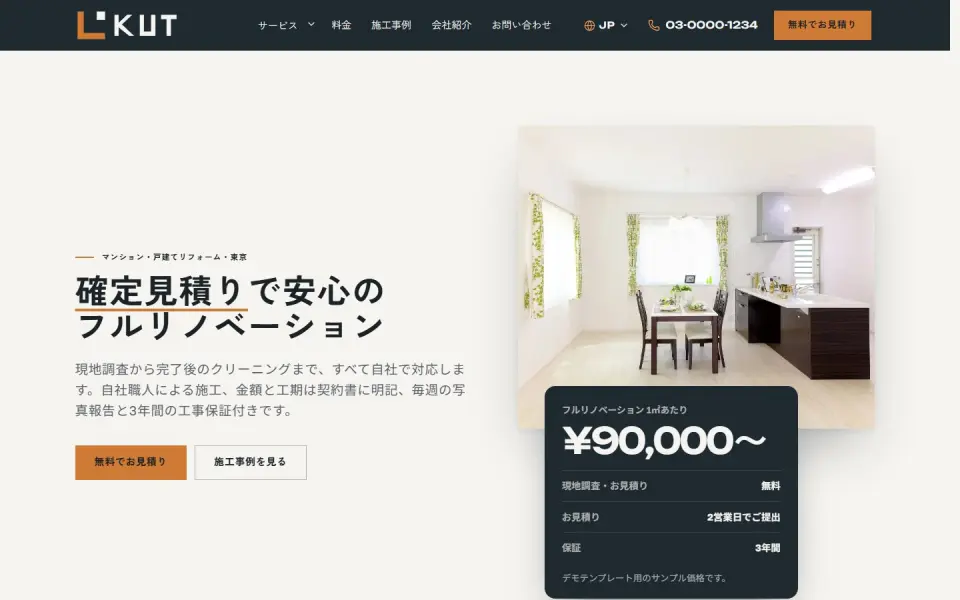 Renovation – KUTEstimate request, projects and prices
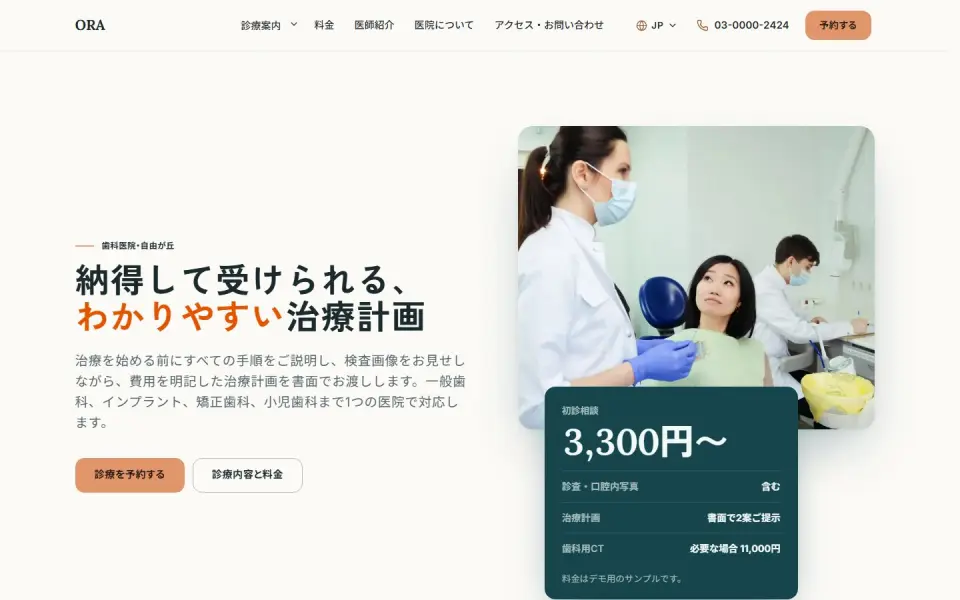 Dental clinic – ORATreatments, prices, doctors and booking
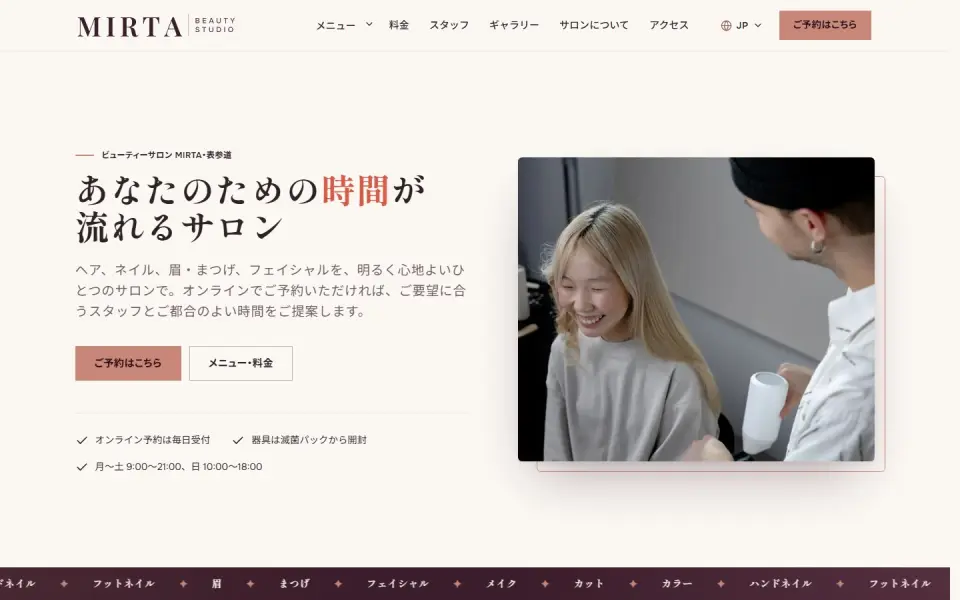 Beauty salon – MIRTABooking form, price list and team
Template demos with fictional brands. Yours is built with your own brand and content.
What to do yourself and what to outsource
Some SEO tasks are easy to handle in-house; others need specialist knowledge or a solid block of time. Sorting them by the time you can realistically give makes the decision much easier.
- Easy to do yourself: updating your Google Business Profile, writing service and pricing copy, adding common customer questions, replacing photos, posting news
- Doable with a little learning: reading Search Console, rewriting titles and descriptions, organizing keywords, adding internal links between related pages
- Worth outsourcing: rethinking the site structure, speeding up the site, structured data, redirects during a renewal, CMS and theme updates, preparing content for AI answers (GEO)
Outsourcing pays off when the foundation of the site needs work, or when nobody in-house has time for monthly improvements. You still know your strengths best, so a split that works well is: you supply the raw material for the copy, the specialist handles structure and the technical side. Our guide to SEO outsourcing covers how to pick a provider and what to check in the contract.
Once you see a demo with the structure and technical side in place, it is clear which tasks stay with you and which to hand over.
How UNANOBO approaches SEO: a free demo with a search-ready structure
At UNANOBO, SEO work starts with a free demo too. We look at your current site and services, then build a working demo with a page structure, titles, headings and mobile layout shaped around the searches you want to be found for. Looking at it together makes it easy to decide what you will keep doing yourself and what to hand over.
The process is simple: free demo, feedback, launch, growth. The founder handles every project personally, from the first demo to improvements after launch, and suggests new pages and edits based on Search Console and GA4 data. Everything runs by message, in Japanese or English, and your analytics accounts stay in your name.
How it works
- 01
Free demo
We start with a free demo built around your brand.
- 02
Feedback
Structure, tone and details are refined with you, on the demo itself.
- 03
Launch
The site goes live on a solid SEO foundation.
- 04
Growth
SEO and ads take it further, guided by the numbers.
FAQ
How long does SEO take to show results?
It depends on your site and the competition, but changes and new pages typically take three to six months to show a visible effect. Rankings are decided by search engines, so no specific position or timeline can be promised. Tracking impressions and clicks in Search Console is the best way to judge progress.
How much time does DIY SEO need?
Plan a few days for the initial measurement setup and keyword work, then a few hours a month for checks and updates. Rewriting service pages takes a bit longer, so set that time aside. A fixed monthly slot helps you keep going.
Does the free demo cost anything, and what if I do not go ahead?
The demo is free. If you decide not to continue after seeing it, there is no charge at all. The page structure you saw in the demo can still guide your own SEO work.
What should I prepare before getting in touch?
Your current site address and the kind of inquiries you want more of – bookings, quote requests and so on – are enough. If Search Console or GA4 is already set up, sharing what you see there speeds things up. No site yet? A description of your services and your logo are enough to start.
Can we work on SEO by message only?
Yes. Demo links, suggested changes and reports all come by message, so everything is in writing and you can read it when it suits you. We work in Japanese or English and aim to reply within two business days.
Do I also need to prepare for AI answers (GEO)?
AI summaries in search results and chat assistants increasingly quote business information. The foundation is the same as SEO: clear, accurate details about who you are, what you offer, typical prices and common questions. UNANOBO organizes your content with both SEO and GEO in mind.
Related pages
FREE DEMO
See a search-ready version of your site
Send us your current site address and we will build a free demo with a structure shaped around the searches you want to win. Decide after you have seen it.