
Restaurant marketing in Japan – more ways for diners to find you, starting with your own site
For most restaurants in Japan, marketing starts and ends with a listing on a gourmet portal. Diners, though, compare places across Google Maps, Instagram and AI answers before they book. This page shows how to build entry points under your own name – your website, Google Business Profile, AI-answer visibility and Meta ads – step by step.
- Free demo – decide after you see it
- By message, in Japanese or English
- One person from demo to launch
FREE DEMO
See your restaurant's website – free
Send us your restaurant name and your Google Maps or Instagram link. We build a free demo of your website with your menu and atmosphere, and you decide after seeing it.
- A free demo built around your menu and photos
- Try booking and directions on your phone
- Tips for Google Maps and ads included
Restaurant marketing starts with where diners search
The first question in restaurant marketing in Japan is simple: where do people find you, and where do they decide to come? Even for the same goal – lunch nearby – people use different channels.
- Google Maps and Google Search: "ramen near Shibuya Station", "izakaya near me" – people searching from where they are right now
- Gourmet portals: Tabelog, Hot Pepper Gourmet and similar sites, where people filter and compare, often for bookings or coupons
- Instagram: photos of dishes and interiors create the "I want to go there" moment; many save a post and visit later
- AI answers: more people ask ChatGPT or Google's AI Overviews things like "family-friendly cafe near Ebisu" and look up the places named
- Your own website: where people who found you anywhere above check the menu, prices, hours and atmosphere before deciding
Whatever the entry point, a visit happens when the final check answers every question. Start by searching your restaurant's name on Google and Google Maps and see whether what appears matches your restaurant today.
What happens when a portal is your only channel
Gourmet portals are useful for taking bookings. Relying on them for everything, though, tends to create the same problems:
- Visibility depends on your listing plan, and bookings drop when you lower the fee
- You sit side by side with nearby competitors, so price and coupons often decide
- Guest contacts and visit history mostly stay on the platform, which makes repeat marketing harder
- Photos and copy fit a fixed template, so your character is hard to show
- If you stop the listing, you lose your only place to take online bookings
Keep the portal if it works, and grow your own website and Google Maps presence alongside it. Write down where your bookings came from over the last three months – it quickly shows where to focus.
Send us your restaurant name and Google Maps link, and we will build a free demo of your website.
Set up your Google Business Profile
The information shown on Google Maps is managed through Google Business Profile. It is free to create and use, and it is usually the quickest win for a restaurant. Work through these points in order:
- Basics: name, address, phone, hours and closing days written exactly as on your website, plus special hours for holidays
- Category: choose the main category that matches your format – yakiniku restaurant, cafe and so on
- Menu and photos: signature dishes, the exterior, the entrance, the dining room and seats in bright photos; refresh seasonal items
- Booking link: point to the booking page on your site or your reservation service
- Review replies: answer good and critical reviews alike, specifically and politely
- Posts: share limited menus, events or temporary closures a few times a month
Note that offering rewards in exchange for reviews is against Google's policies. For more on map search, see our page on MEO services.
What the free demo gives you
- 01A working demoA demo site you can open and click through on a computer and a phone.
- 02A structure proposalWhich pages you need, what goes on each and where visitors get in touch.
- 03Plan and estimateAfter you have seen the demo you get the plan to launch and an estimate.
Why it is safe to ask
- The demo is free. If you decide not to go ahead, it costs you nothing.
- Everything happens by message, in Japanese or English.
- Your domain, hosting, ad and analytics accounts stay in your name.
- The founder handles your project from the first demo to growth after launch – one contact all the way.
Demo sites we built
 Café & roastery – KashtanMenu, events and an online bean shop
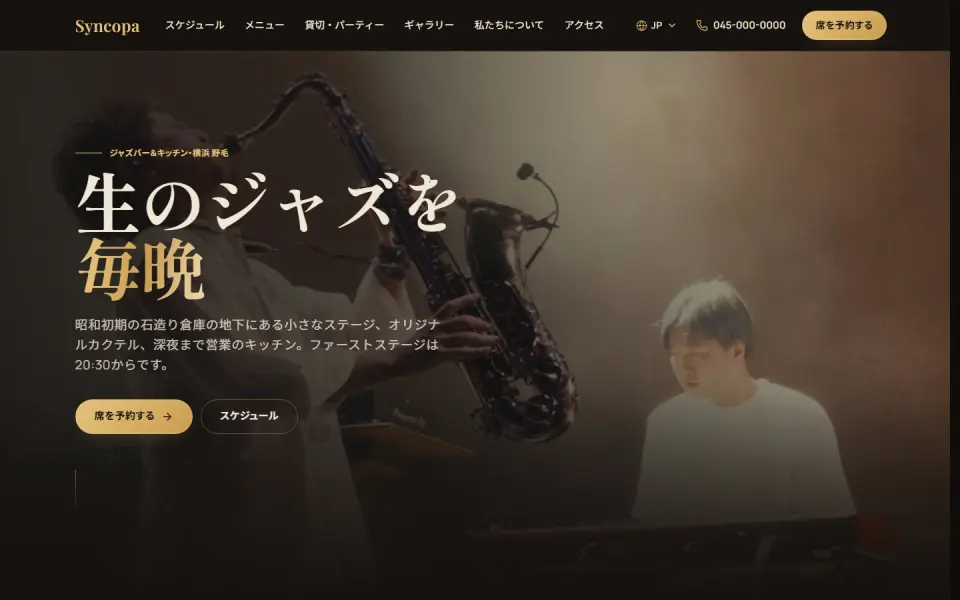 Jazz bar – SyncopaLive schedule, menu and table booking
 Beauty salon – MIRTABooking form, price list and team
Template demos with fictional brands. Yours is built with your own brand and content.
Prepare your website for search and AI answers
Your website is where people decide to visit, and it is also a main source search engines and AI tools read to understand your restaurant. Nobody can guarantee that an AI will mention you, but you can make your information easy to read correctly:
- Publish the menu and prices as text as well as images
- State the features people ask about: private rooms, kids welcome, vegetarian options, English menu
- Put the address, directions from the nearest station, parking and payment methods on one page
- Add an FAQ covering bookings, private hire and other common questions
- Use structured data (such as Restaurant) to pass your name, address and hours to search engines
- Make call, booking and map buttons easy to tap on a phone
Our guide to restaurant website design covers structure and pages in detail. If you already have a site, check two things first: can the menu be read as text, and can a phone user reach the booking page in a few taps?
We build a free demo from your current menu and photos, with booking a few taps away on a phone.
Use Instagram and Meta ads to create the urge to visit
Food is visual, which makes restaurants a natural fit for Instagram and Meta ads on Facebook and Instagram. Ads can start on a small budget and target the area around your restaurant, plus age and interests.
- Area: target the range people can reach on foot or by train; in office districts, think about lunchtime
- Photos and video: short clips with sizzling sound or steam tend to stop the scroll better than still images
- Destination: send people to your booking page or Google Maps so they can reserve right away
- Tracking: use GA4 and the Meta pixel to see how many ad viewers reached the booking page
Restaurants near tourist spots or major stations can add English information and ads for international visitors – see inbound tourism ads. Open the ad account in your restaurant's name so you keep control whoever runs it.
How UNANOBO helps restaurants: a free demo of your site first
Before you commit to anything, UNANOBO builds a free demo of your restaurant's website, based on your menu, photos and atmosphere. You try the path to booking and directions on your phone and decide whether to go ahead once you like it.
The process is free demo, feedback, launch, growth. After launch the founder personally handles Google Business Profile, SEO and AI-answer visibility, and Meta or Google ads – one contact for everything. Communication runs by message in Japanese or English, so you can reply between prep and service.
How it works
- 01
Free demo
We start with a free demo built around your brand.
- 02
Feedback
Structure, tone and details are refined with you, on the demo itself.
- 03
Launch
The site goes live on a solid SEO foundation.
- 04
Growth
SEO and ads take it further, guided by the numbers.
FAQ
Does the free demo cost anything?
No, the demo is free. We build a working demo of your site, centered on the home page, from your restaurant's details, and you check it on a phone and a computer. You decide whether to continue after seeing it.
What if I decide not to go ahead?
That is fine. If you choose not to continue after seeing the demo, there is no cost at all. If it shows that another step should come first for your restaurant, that is useful to know too.
Should I stop using gourmet portals?
There is no need to. If a portal brings bookings, keep it while you build your website and Google Maps presence. Once you can see bookings by channel, it is much easier to decide which listing plan is worth paying for.
What do I need to prepare?
Your restaurant name, address, hours, menu with prices, logo files if you have them, and photos of dishes and the interior. Links to your Google Maps listing and Instagram help us reflect your style in the demo. If photos are limited, we can settle the layout first and plan a shoot later.
I am too busy running the restaurant for meetings. Is that a problem?
Not at all. Everything runs by message, so you can reply between services or after closing. You get a reply within two business days, in Japanese or English.
How long until the site goes live?
It depends on the number of pages and how ready your materials are; for a small restaurant site, one to two months is typical. After the demo you receive a concrete schedule and estimate.
Related pages
FREE DEMO
See your restaurant's website first
Send us your name, menu and a few photos, and we will build a free demo of a website that shows your atmosphere. Decide after you have seen it.