
Recruitment website design in Japan – a careers site applicants actually read
Job boards bring candidates to your name, and the next thing most of them do is look you up. A recruitment website is where they check what the work is really like, who they would work with and how to apply. This page covers what applicants look for, structure and budget, links with job boards and ads, and UNANOBO's free demo built from your job posts.
- Free demo – decide after you see it
- By message, in Japanese or English
- One person from demo to launch
FREE DEMO
Turn your job posts into a careers site – free
Send us your current site address or a job listing. We build a free demo of a recruitment website with your roles and job details organized, and you decide after you have seen it.
- A careers site demo built from your job posts
- Job pages and an application path, structured
- A plan to connect job boards and ads
What applicants look for on a recruitment website
Candidates who find you on a job board usually search your company name before they apply. They want to picture themselves in the job, and a list of conditions rarely does that. Good recruitment website design in Japan covers six areas:
- The work itself: a typical day, main tasks and what a new hire is trusted with
- The people: staff voices, their backgrounds and who does well in the role
- Terms and support: how pay works, days off, hours, training and evaluation
- The workplace: photos of the site and tools, commute and surroundings
- Direction: a message from the owner and where the business is heading
- How to apply: selection steps, whether visits or casual talks are possible, a contact
"A day in the job" and staff voices are the two things a job ad almost never conveys. Start by writing down what your team can already talk about – that list becomes the raw material for the site.
Job boards and your own careers site: different jobs
Job boards and job search engines are where people discover openings. Their format is fixed – limited text, limited photos, a standard layout – and the listing disappears when the paid period ends. Your own careers site stays, and it shows the same story to everyone, whether they come from a job board, social media, an ad or a referral. A dedicated site is worth it if:
- Applications come in, but candidates drop out because "the job is not what I expected"
- Searching your company name shows almost nothing about working there
- You keep paying for listings and applications rise and fall with each campaign
- The people you want to reach – younger staff, returnees to the region – research on social media
- Staff want to refer friends but have no page to send them to
A careers site works best together with job boards. Put its URL in every listing and let the site carry the detail; candidates arrive better informed and mismatches after hiring become less likely.
We build a free demo of a careers site candidates can read before they apply, using your current job posts.
How to build a recruitment website: structure and steps
For a small or mid-sized company, five to eight pages are usually enough. With only one or two roles, a single long page can work too. The core pages:
- Home: one clear hiring message and links to each open role
- Job pages: tasks and a typical day for each role
- Staff interviews: two to four people across roles and years of service
- Company in numbers: average age, paid leave taken and similar, where you can share them
- Job details: pay, location, hours, days off and requirements per role
- FAQ and application form: the selection flow and a contact for questions
The usual order: define who you want to hire, decide what to show and whom to interview, prepare copy and photos, design and build, then launch with tracking in place. If writing is where things stall, see how to prepare website copy. Japanese law, including the Employment Security Act, sets out which working conditions a job posting must state, and the rules are revised from time to time, so check the latest guidance from the Ministry of Health, Labour and Welfare when writing job details.
What the free demo gives you
- 01A working demoA demo site you can open and click through on a computer and a phone.
- 02A structure proposalWhich pages you need, what goes on each and where visitors get in touch.
- 03Plan and estimateAfter you have seen the demo you get the plan to launch and an estimate.
Why it is safe to ask
- The demo is free. If you decide not to go ahead, it costs you nothing.
- Everything happens by message, in Japanese or English.
- Your domain, hosting, ad and analytics accounts stay in your name.
- The founder handles your project from the first demo to growth after launch – one contact all the way.
Demo sites we built
 Dental clinic – ORATreatments, prices, doctors and booking
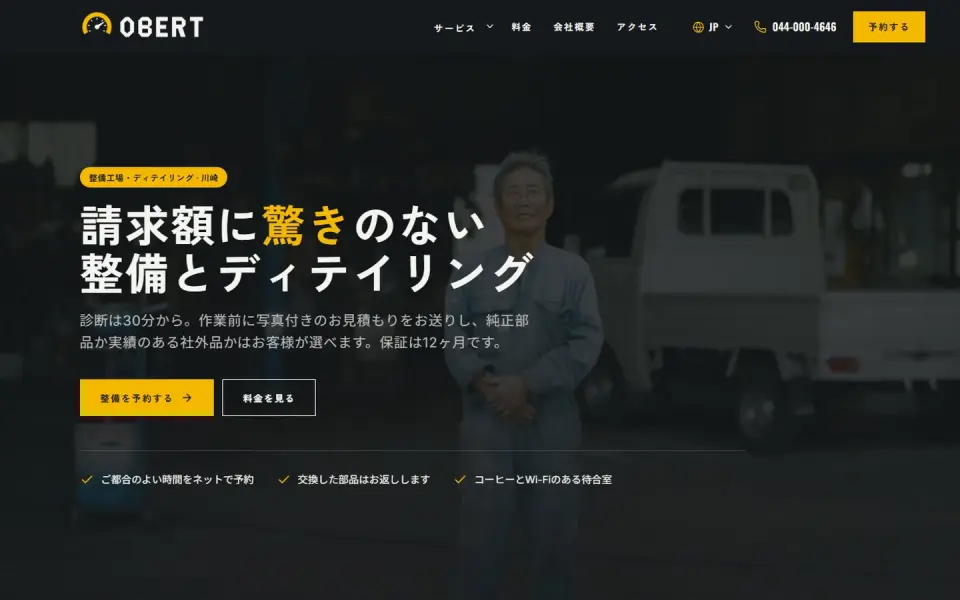 Car service – OBERTService and detailing prices, booking
 Beauty salon – MIRTABooking form, price list and team
Template demos with fictional brands. Yours is built with your own brand and content.
Designing the site to work with job boards and ads
A careers site needs traffic. Planning the routes in from the start makes the money you already spend on listings and ads go further.
- Job search: add JobPosting structured data to job pages so they can appear in Google's job search; check each job board's current rules for how listings are accepted
- Links from job boards: add the site URL or a QR code to every listing and printed job sheet
- Landing pages for social ads: mobile-first pages per role for people arriving from Instagram or Facebook ads
- Tracking: measure application form submissions in GA4 to see which channel brings applicants
- Easy applying: keep the form short and offer a phone or LINE option for questions
If you want to reach more candidates through social ads, our page on Meta ads management explains the approach. Keep ad and analytics accounts in the company's name so access stays with you when people change.
Click through the path from job page to application form in a free demo.
Typical costs and common mistakes
Cost depends on page count, whether interviews and photo shoots are included and who writes the copy. As a general guide in Japan, a small template-based careers site typically starts from a few hundred thousand yen, while a full production with interviews, photography and video can reach several million yen. When comparing quotes, check whether copywriting and photography are included. Watch for these mistakes as well:
- Copy that could describe any company, such as "a friendly, family-like workplace"
- Outdated job details, with pay or location that no longer match reality
- Pages that are hard to read on a phone, so candidates never reach the form
- Interviews that only share the good parts and say nothing about who the job suits
- No one assigned to updates, so closed roles stay online for months
If your company profile and service pages also need work, planning them together with corporate website design gives each site a clear role.
How UNANOBO builds recruitment websites: a free demo first
Before you commit, UNANOBO builds a free demo of your recruitment website, based on your current site and job posts. You see how job pages and job details look on a computer and a phone, and decide whether to go ahead once you like the direction.
The process is simple: free demo, feedback, launch, growth. The founder handles every project personally, so adding roles, swapping copy or building ad landing pages all go through one contact. Everything runs by message, in Japanese or English.
How it works
- 01
Free demo
We start with a free demo built around your brand.
- 02
Feedback
Structure, tone and details are refined with you, on the demo itself.
- 03
Launch
The site goes live on a solid SEO foundation.
- 04
Growth
SEO and ads take it further, guided by the numbers.
FAQ
What do you need from us for the free demo?
Your current website URL and a job board listing or job sheet are enough. A line about the roles and the kind of person you want to hire makes the structure more specific. Staff interviews and photos can wait until after you have seen the demo.
Is there any cost if we decide not to go ahead?
No. The demo is free, and nothing is charged if you decide to stop after seeing it. If you continue, you get a structure proposal, a plan and an estimate based on the demo.
How long does a recruitment website take?
It depends on scope and how ready your materials are, but a five to eight page careers site typically takes one to two months. Staff interviews and photos usually take the longest, so naming someone on your side early keeps things moving.
Can the careers pages live inside our existing website?
Yes. With few roles and infrequent updates, a careers section on your current site is often easier to manage. Whether to build a separate recruitment site is something we look at together during the demo stage.
Can you write the staff interviews?
Yes. You receive a list of questions, your staff answer by message or in notes, and the answers are shaped into readable stories. For photos, we suggest shooting in-house or booking a local photographer.
Can we work together without meeting in person?
Yes. Everything from the first question to final checks runs by message. Demos and revisions arrive as links, so HR and team members can review them together. You get a reply within two business days.
Related pages
FREE DEMO
See your recruitment website first
Send us your job posts or current site URL and we will build a free demo of your careers site. Decide after you have seen it.