
Hotel website design in Japan – a bilingual official site built for direct bookings
When most reservations come through online travel agencies, commissions add up and the guest relationship belongs to someone else. A well-built official website lets domestic and international guests choose a room and book it with you directly. This page covers the pages a hotel site needs, how to write for overseas guests, how to connect your booking engine and what to check when choosing who builds it.
- Free demo – decide after you see it
- By message, in Japanese or English
- One person from demo to launch
FREE DEMO
Your new hotel website – free demo
Send us your hotel name and the URL of your current site or OTA listing. We build a free demo of a new design focused on direct bookings.
- Room pages and booking flow, designed for free
- See how the English version will look
- Advice on connecting your booking engine
The goal of hotel website design: more bookings on your own site
Rakuten Travel, Jalan, Booking.com and Expedia bring visibility that few hotels can do without. Each booking carries a commission, though – rates depend on your contract, and around 10% or more of the room price is a common reference. Many travelers who find you on an OTA then visit your official site to check details. Good hotel website design makes that visit the place where they book.
Direct bookings give you several advantages:
- Lower distribution cost: a booking engine has its own fees, yet they are usually easier to keep down than OTA commissions
- A direct relationship: you have the guest's contact details for pre-arrival information and repeat stays
- Your own story: room sizes, breakfast and the neighborhood can be shown in full, beyond an OTA listing template
- Room for your own offers: long-stay plans or anniversary extras available only on your site
A useful first step: check how many bookings arrive through OTAs and how many through your own site. That ratio tells you what the new website needs to achieve.
Pages and elements that turn visitors into bookings
Guests compare photos and prices fast and narrow down their options in minutes. Make sure your site has these in place:
- Availability search and a Book button: on the home page and every room page, always reachable on a phone
- Room pages: size in square meters, bed type and width, capacity, smoking policy, amenities and view, all with photos
- Rates and plans: room only vs. with breakfast, child rates and the cancellation policy, stated clearly
- Access: routes from the nearest station and airport, travel times, parking and a map
- Facilities and area: restaurant, baths, laundry, nearby sights and places to eat
- FAQ: check-in and check-out times, luggage storage, payment methods, Wi-Fi
Photos matter most. Shoot the whole room, the bed, the bathroom and the view from the window in daylight, so guests comparing you with OTA listings feel confident. Note which of these elements your current site lacks – that list becomes the scope of the project.
Send us your URL and we will show you a free demo with proper room pages and a clear Book button.
Writing English pages for international guests
Many visitors to Japan research in English and check the official site before they book. Your English pages work best when they answer what overseas guests actually ask:
- Step-by-step access: train line, station exit, transfers and a typical taxi fare
- Local customs: where to take off shoes, how the public bath works, check-in times
- Payment and taxes: accepted cards and cashless options, and whether accommodation tax or bathing tax is added
- Clear room details: square meters, bed width, and for Japanese-style rooms a note that guests sleep on futons
- An English contact: email or messaging, with a typical reply time
Japanese and English pages should live on separate URLs, set up so search engines understand the language of each. If you need Chinese or Korean as well, settle the structure in English first and expand from there – it keeps updates manageable. For properties built around tatami rooms and hot springs, our page on ryokan website design covers the presentation in more detail.
What the free demo gives you
- 01A working demoA demo site you can open and click through on a computer and a phone.
- 02A structure proposalWhich pages you need, what goes on each and where visitors get in touch.
- 03Plan and estimateAfter you have seen the demo you get the plan to launch and an estimate.
Why it is safe to ask
- The demo is free. If you decide not to go ahead, it costs you nothing.
- Everything happens by message, in Japanese or English.
- Your domain, hosting, ad and analytics accounts stay in your name.
- The founder handles your project from the first demo to growth after launch – one contact all the way.
Demo sites we built
 Café & roastery – KashtanMenu, events and an online bean shop
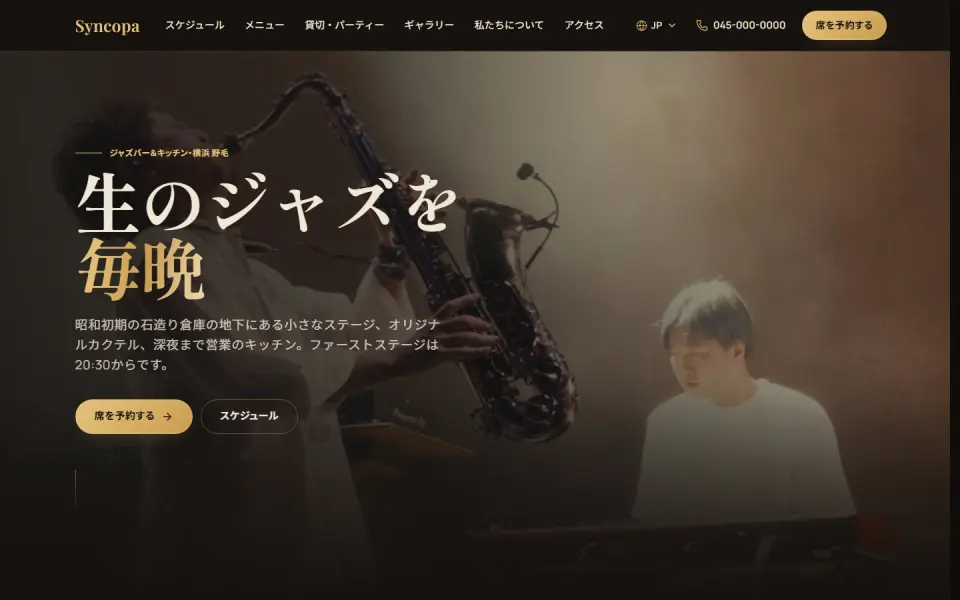 Jazz bar – SyncopaLive schedule, menu and table booking
 Beauty salon – MIRTABooking form, price list and team
Template demos with fictional brands. Yours is built with your own brand and content.
Connecting your booking engine and marketing to the site
A beautiful site still loses guests if the booking step is confusing – they simply go back to the OTA. Link your booking engine to a channel manager so inventory stays in sync with the OTAs, and you can sell the same rooms on your own site without overbooking.
- Language and currency: can guests switch the booking screen to English and pay by card?
- Mobile flow: dates, guests and payment in as few steps as possible
- Visual continuity: your logo and colors on the booking screen, so it still feels like your hotel
- Tracking: GA4 measures completed bookings and shows which pages lead to them
- Google presence: a complete Google Business Profile, so guests can reach your official rates and booking page from Google Search and Maps
For choosing an engine, see hotel booking systems; for growing bookings after launch through search and ads, see hotel and ryokan marketing. Deciding early whether to keep your current engine makes the build much smoother.
Tell us which booking system you use, and the free demo will include the Book button placement.
Choosing a hotel website design studio
Pick a studio that understands how hotels operate. Budgets vary with size and number of languages; typically a hotel site in Japan starts from several hundred thousand yen and can reach several million with multiple languages or custom features. Ask these questions early:
- Can the site work with your current booking engine and channel manager?
- Will they write English copy tailored to international guests?
- Can they tell you exactly which photos are missing and whether a reshoot is needed?
- Can your staff update plans and rates through an admin panel?
- Will the domain, GA4 and Google Business Profile stay in the hotel's name?
- Can updates and marketing continue with the same contact after launch?
To speed things up, prepare your logo files, room and facility photos, a list of room types and capacities, the name of your booking engine and two or three hotel sites you like. You can start with whatever you have on hand.
How UNANOBO builds hotel websites: a free demo first
Before you commit, UNANOBO builds a free demo of your new official site, based on your brand and the content on your current site or OTA listings. You check the room pages, the Book button placement and the English version on a computer and a phone, then decide whether to go ahead.
The process is simple: free demo, feedback, launch, growth. The founder handles every project personally, so you keep one contact from the first demo to marketing after launch. Everything runs by message, in Japanese or English – convenient for international owners and for managers who prefer to discuss things in English.
How it works
- 01
Free demo
We start with a free demo built around your brand.
- 02
Feedback
Structure, tone and details are refined with you, on the demo itself.
- 03
Launch
The site goes live on a solid SEO foundation.
- 04
Growth
SEO and ads take it further, guided by the numbers.
FAQ
What does the free demo include?
A working new design, centered on the home page, built from your logo, colors and current content. You can see the room presentation, the Book button placement and the mobile view. It costs nothing.
What if I decide not to go ahead after the demo?
That is completely fine, and there is no charge. If you do want to continue, you receive a structure proposal, a plan and an estimate after the demo.
Can I keep my current booking engine?
In most cases, yes – your current engine can be connected to the new site. We check its specifications before proposing how to place the availability search and Book buttons. If you are thinking of switching, we can help you compare options too.
Can you write the English content?
Yes. Starting from your Japanese content, we write English pages that add the access details and house rules overseas guests look for. Since we work in both languages, reviewing the text is straightforward.
How long does it take to launch?
It depends on room types, number of pages and languages, but one to two months is a typical timeline for a small hotel. Having photos and room details ready speeds things up. We reply to messages within two business days.
Can we do everything by message, without meeting?
Yes. UNANOBO works remotely from outside Japan and runs every project by message, from the first inquiry to support after launch. Demo reviews and feedback happen in writing, so you can respond between front desk tasks.
Related pages
FREE DEMO
See your new hotel website first
Send us your hotel name and current site URL, and we will build a free demo of a new design made for direct bookings. Decide after you have seen it.