
Inbound tourism SEO in Japan – get found by visitors searching in their language
Inbound tourism SEO means making sure your shop, restaurant or venue appears when visitors to Japan search in English, Chinese, Korean and other languages. A translated copy of a Japanese site rarely matches the words travelers use or the questions they need answered, so it often stays invisible in search. This page covers how visitors search, how to set up languages and URLs, how to pick keywords and what to check before launch – and how UNANOBO starts by showing you a free demo of your English pages.
- Free demo – decide after you see it
- By message, in Japanese or English
- One person from demo to launch
FREE DEMO
See your English pages for visitors – free
Send us your current site address or business details. We build a free demo of English pages with what visitors need to know, and you decide after seeing it.
- English pages built from your current info
- A traveler-focused layout to check on mobile
- A language and URL plan included
Inbound tourism SEO: when and how visitors search
Your audience searches at two moments: before the trip and during it. At home they plan on a laptop or phone with queries that combine a place and an experience, such as "Kyoto kimono rental" or "best sushi Tsukiji". Once in Japan they search for what is nearby, such as "ramen near me". Most of this happens on Google and Google Maps, with review sites and Instagram open alongside.
- Before the trip: shortlisting places, booking, checking prices and opening hours
- On the move: finding somewhere close, directions, crowds and payment options
- Right before visiting: the menu, whether booking is needed, language support, cards and e-payments
So you need two things: to show up in results, and to look like a safe choice once someone clicks. Start by working out at which moment your typical guest searches, and prioritize the pages that serve it.
Signs visitors cannot find your site
If any of these apply, your English site probably gets very few search impressions, even if it exists.
- There is a single English page, while the menu, prices and access are only in Japanese
- Languages switch through a translate button, with no separate URL per language
- Your name or menu appears only as Japanese text inside images
- There is no English address or directions from the nearest station
- Your Google Business Profile description and photos are aimed at Japanese customers
- You have never checked impressions by country in Search Console
All of these are fixable. For the wider picture of a tourist-ready site, see websites for inbound tourism; for search in English-speaking markets specifically, see English SEO.
Send us your site address and we will show you, in a free demo, English pages built to reach visitors.
Languages and URLs: the foundation of multilingual SEO
Search engines treat each language as its own set of pages. On-screen translation widgets rarely get indexed as English pages, so the standard approach is a dedicated URL for each language.
- URL structure: folders such as example.com/en/, /zh-tw/ and /ko/ share your domain's strength and are easy to manage
- hreflang: tags that tell search engines which pages are language versions of each other, so searchers see the version in their language
- Which languages: start with English, then add Traditional Chinese (Taiwan, Hong Kong), Simplified Chinese or Korean depending on your guests
- Translation quality: use machine translation as a draft only and have a native speaker review it; use the names for dishes and experiences that visitors actually recognize
- Language switcher: a menu at the top of every page that leads to the same content in another language
You do not need every language at once. Build the key English pages first – home, menu or services, access and booking – then add languages for the countries that bring the most visits. That way quality stays high as you grow.
What the free demo gives you
- 01A working demoA demo site you can open and click through on a computer and a phone.
- 02A structure proposalWhich pages you need, what goes on each and where visitors get in touch.
- 03Plan and estimateAfter you have seen the demo you get the plan to launch and an estimate.
Why it is safe to ask
- The demo is free. If you decide not to go ahead, it costs you nothing.
- Everything happens by message, in Japanese or English.
- Your domain, hosting, ad and analytics accounts stay in your name.
- The founder handles your project from the first demo to growth after launch – one contact all the way.
Demo sites we built
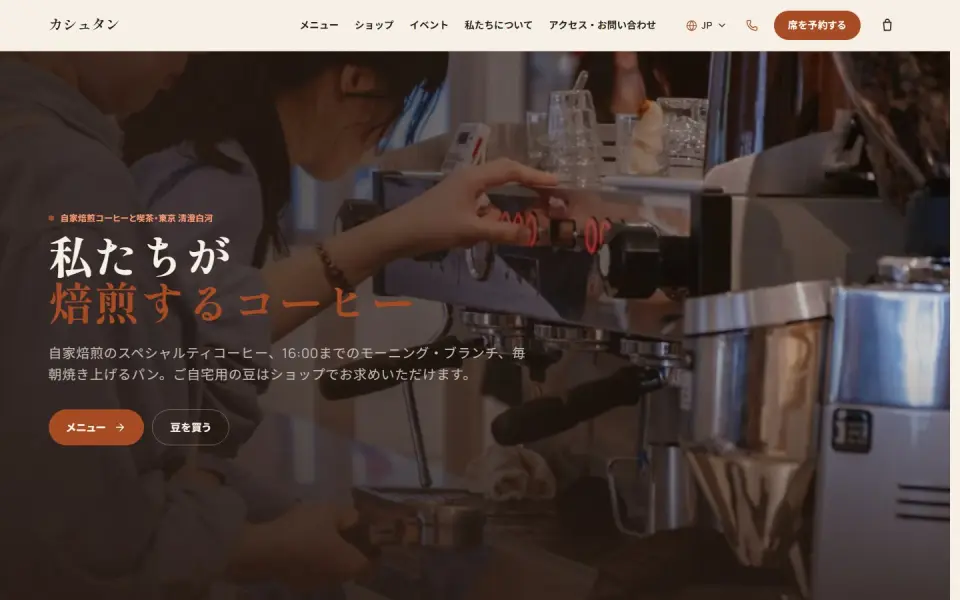 Café & roastery – KashtanMenu, events and an online bean shop
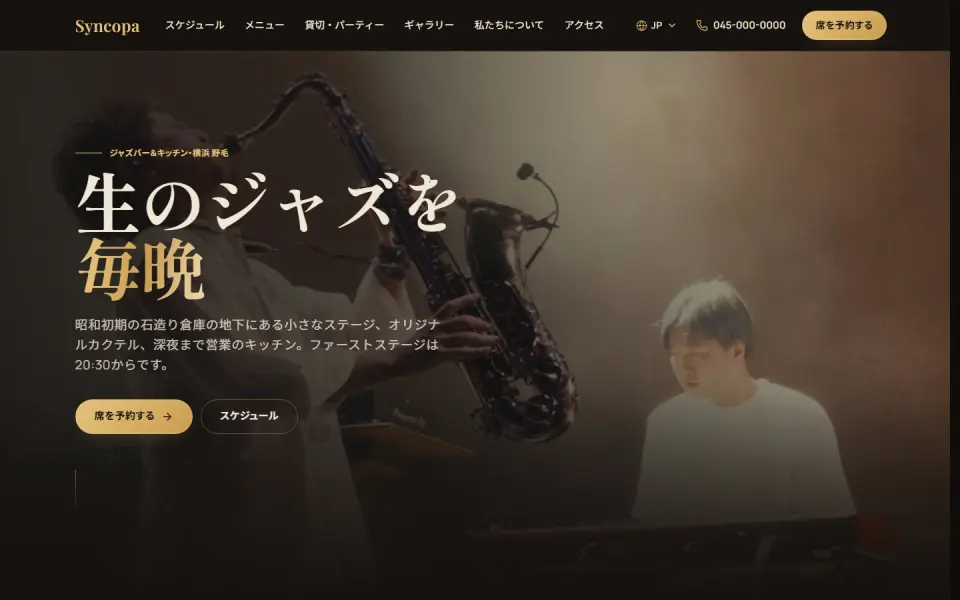 Jazz bar – SyncopaLive schedule, menu and table booking
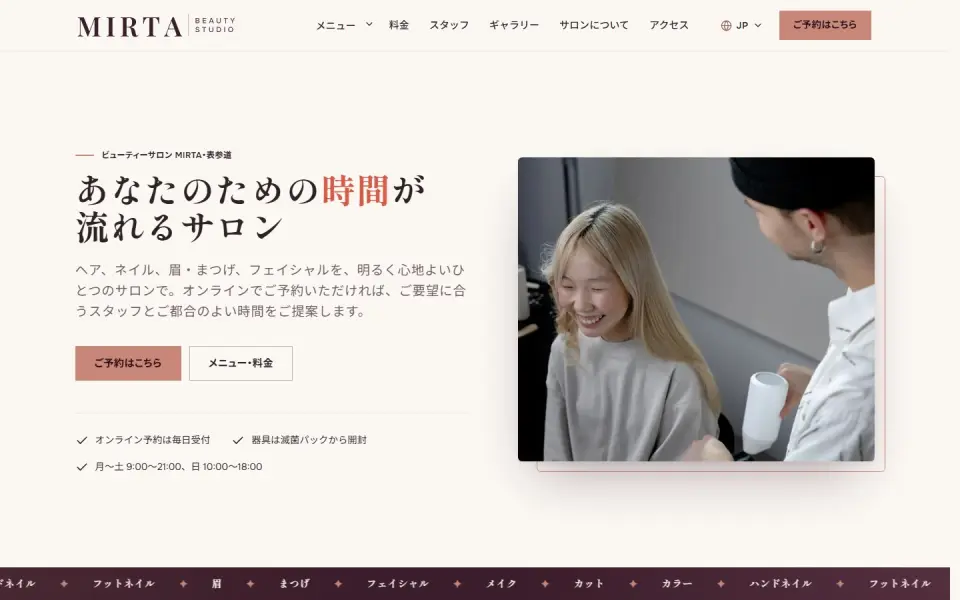 Beauty salon – MIRTABooking form, price list and team
Template demos with fictional brands. Yours is built with your own brand and content.
Keywords and pages in the visitor's own words
Translating your Japanese keywords will not get you found. Visitors search along their itinerary: place plus experience, place plus food, or a station name plus "near".
- Be specific about places: alongside "Tokyo", use district and station names such as Asakusa or Shibuya in titles and copy
- Name the experience: make the goal itself the heading – "tea ceremony experience", "private onsen", "vegan ramen"
- Answer traveler worries: how to book, whether there is an English menu, payment methods, vegetarian or halal options, whether children are welcome
- Explain how to get there: station exit, minutes on foot and a landmark, written in English
- Structured data: mark up business details, hours, price range and FAQs so your search listing looks complete
Add an English description, hours, photos and a booking link to your Google Business Profile as well, so Google Maps "near me" searches and your website support each other. While organic rankings build up, ads for inbound tourists can cover the travel season.
Menu, directions and booking, all in English – preview the structure in a free demo first.
Checks before launch, and how to measure after
Multilingual pages are where small mistakes slip through most easily. Run through this list before going live:
- Each language page has a title and description written in that language
- hreflang links point both ways and every URL is correct
- Pages load quickly on a phone from abroad and images are not oversized
- Booking and contact forms accept foreign names and overseas phone numbers
- The sitemap lists every language URL and is submitted in Search Console
After launch, Search Console shows impressions and clicks by country and page, and GA4 shows views, bookings and inquiries by language. Once you know which countries find you and with which words, you can choose the next page or language with confidence. Results typically take a few months, so it pays to start well before your peak season.
How UNANOBO handles inbound SEO: a free demo of your English pages
Before you commit to anything, UNANOBO builds a free demo of your English pages, based on your current site or business details. It covers what visitors want to know – menu, prices, directions, how to book – and you can click through it on a computer and a phone.
The process is free demo, feedback, launch, growth. The founder handles every project personally: language and URL planning, translation review, hreflang and structured data, your Google Business Profile and improvements after launch, all through one contact. Everything runs by message, in Japanese or English, so you can discuss English copy directly in English.
How it works
- 01
Free demo
We start with a free demo built around your brand.
- 02
Feedback
Structure, tone and details are refined with you, on the demo itself.
- 03
Launch
The site goes live on a solid SEO foundation.
- 04
Growth
SEO and ads take it further, guided by the numbers.
FAQ
What does the free demo include?
A working English version centered on the home page, built from your current site or business details. You can see how the menu, directions and booking are presented. You decide whether to continue after seeing it.
Is there any cost if I decide not to go ahead?
No. The demo is free, and you can say no after seeing it. If you go ahead, you receive a plan and estimate that reflect your feedback on the demo.
Can you handle languages other than English?
Yes. The site can be planned with English as the base and Traditional Chinese, Simplified Chinese, Korean or other language pages added for your guests. Translations are polished beyond machine output, with a separate URL and hreflang for each language. We choose where to start together, based on where your visitors come from.
How long until visitors find us in search?
New pages usually get indexed within days or weeks, while steady visibility for target searches typically takes a few months. Rankings are decided by search engines, so no specific position can be promised. After launch we track results by country in Search Console and keep improving.
What do I need to prepare?
Your current site address, menu or price list, photos of the space or dishes, address and nearest station, and how guests book. English copy is not required – we can work from your Japanese information. Access to your Google Business Profile, if you have one, makes things faster.
Can we work only by message, even from abroad?
Yes. Everything from the first questions to improvements after launch runs by message, in Japanese or English, with replies within two business days. You can review things between shifts at your own pace.
Related pages
FREE DEMO
See English pages that visitors can find
Send us your site address or business details and we will build a free demo of your English pages. Decide after you have seen it.