
A website for foreign tourists in Japan – easy to find, easy to visit
Foreign tourists check opening hours, prices, directions, booking and payment on their phones before they visit – and if your site does not answer in a language they read, they pick the place next door. This page shows how shops, restaurants and lodgings in Japan can make their website work for inbound visitors, with practical checklists for language pages, maps, booking and payment information.
- Free demo – decide after you see it
- By message, in Japanese or English
- One person from demo to launch
FREE DEMO
See your tourist-ready page – free
Send us your site address or Google Maps link. We build a free demo of an English page for foreign visitors, and you decide after seeing it.
- An English page built from your own information
- A clear layout for menu, access and booking
- Click through it on your phone
What a website for foreign tourists needs to do
Most visitors to Japan find places on Google Maps or through search, often while already walking around the neighborhood. After the photos and reviews, they open the official website to confirm the details. That final check is where your site wins or loses the visit.
Travelers look for slightly different things than local customers. Make these five points clear even to someone who reads no Japanese at all:
- What you offer: food, products or services, shown with photos and short English text
- Prices: tax-included prices, course or room rates, any extra charges
- How to get there: nearest station and exit, a map, a photo of the entrance, which floor you are on
- Booking and payment: whether a reservation is needed and how to make one, accepted cards and QR payments
- Rules: hours, closing days, seats, cancellation policy, house rules
Try this today: open your site on a phone, pretend you cannot read Japanese and see whether those five points come through. The more you can say with photos and numbers, the less text you need to translate.
Where inbound visitors drop off
Being found on the map is only half the job. These are the most common reasons a tourist leaves a site without booking or visiting:
- The menu or price list exists only as an image or PDF that translation apps struggle with
- Reservations are by phone only, with no way to ask a question in English
- There is an English home page, but the menu and directions are still in Japanese
- Raw machine translation turns dish names and place names into confusing English
- Hours or closing days on Google Maps do not match the website
- Nothing says whether cards are accepted or the place is cash only
None of these needs a full rebuild. Mark the ones that apply and fix booking, payment and directions first – they decide whether people actually show up.
We build a free demo with your menu, booking and directions set out in English.
Choosing languages: English, Chinese and beyond
Every language you add means more translation and more updates. A realistic plan starts with English and adds languages based on where your guests actually come from.
- English: readable for travelers from Europe, North America and much of Asia, so it comes first
- Chinese: Simplified for mainland China, Traditional for Taiwan and Hong Kong – the scripts differ, so prepare them separately
- Korean: worth adding if many guests in your area or industry come from Korea
- Which pages: home, menu and prices, access, booking and FAQ cover the essentials
Machine translation is a fine first draft, but have a person check dish names, product names and any warnings. Give each language its own URL, such as /en/, and use hreflang tags so search engines show the right version to each reader. Our guide to multilingual website production covers language switchers and translation workflows in more detail.
What the free demo gives you
- 01A working demoA demo site you can open and click through on a computer and a phone.
- 02A structure proposalWhich pages you need, what goes on each and where visitors get in touch.
- 03Plan and estimateAfter you have seen the demo you get the plan to launch and an estimate.
Why it is safe to ask
- The demo is free. If you decide not to go ahead, it costs you nothing.
- Everything happens by message, in Japanese or English.
- Your domain, hosting, ad and analytics accounts stay in your name.
- The founder handles your project from the first demo to growth after launch – one contact all the way.
Demo sites we built
 Café & roastery – KashtanMenu, events and an online bean shop
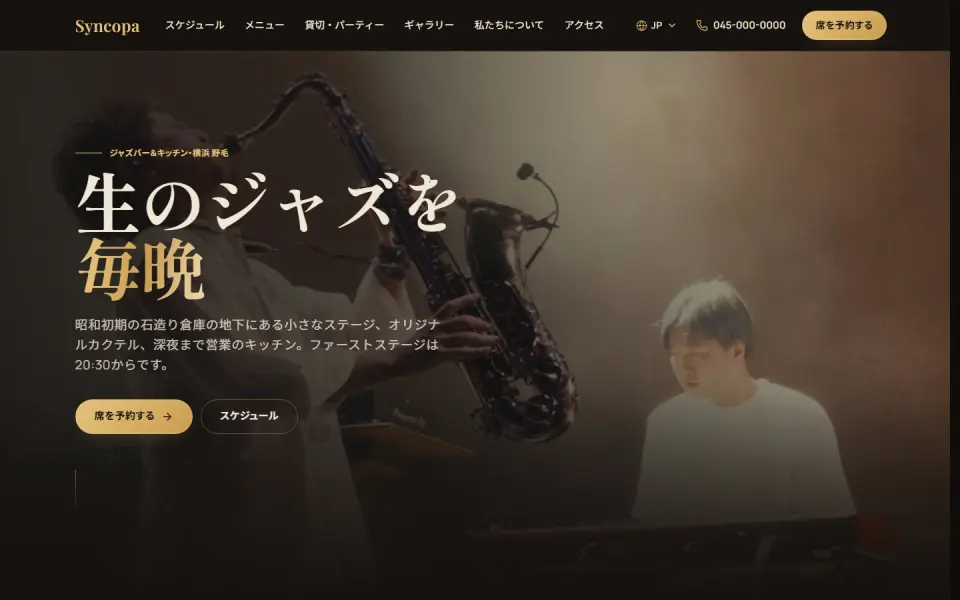 Jazz bar – SyncopaLive schedule, menu and table booking
 Beauty salon – MIRTABooking form, price list and team
Template demos with fictional brands. Yours is built with your own brand and content.
Maps, booking and payment info by business type
Right before a visit, people look for directions, booking and payment details. Put these on your foreign-language pages and you will answer most questions before anyone has to ask:
- Shops and retail: whether you offer tax-free sales, accepted payment methods, holds or overseas shipping, step-by-step directions with photos
- Restaurants: a photo menu with tax-included prices, what you can handle for allergies, vegetarian or halal requests, how to book, any seating charge (otoshi) or service fee
- Lodgings: check-in and check-out times and method, key pickup, house rules, routes from the station and airport, the nearest convenience store and ATM
- Everyone: a Google Maps link, an entrance photo, the address in romaji, Wi-Fi, and a way to contact you in English (form, email or a messaging app)
Connecting a booking service that works in English lets guests in other time zones reserve without calling. Tax-free and payment rules in Japan are being revised, so check the latest guidance from the Japan Tourism Agency and the National Tax Agency before you publish. Running a guesthouse or minpaku? See websites for small lodgings.
Send your site or Google Maps link and get a free demo with access and booking details in place.
Connecting your site to where tourists search
Once the site is ready, bring travelers to it from the places they already use to plan. Work through these four steps after launch:
- Google Business Profile: match hours, photos and the website link with your site, and reply to English reviews in English
- Search in other languages: write a title and description for each language page, using the words travelers actually type
- Ads: reach people planning a trip to Japan or already staying nearby, targeted by area and language
- Measurement: use GA4 to see visits by country and language and clicks on the booking button
For more, see inbound SEO on getting found in foreign-language search and inbound advertising on targeting tourists by area and language.
How UNANOBO helps: a free demo of your tourist-ready pages
Before you commit to anything, UNANOBO builds a free demo based on your current website or shop information: an English page with your menu or rates, access and booking details laid out the way a visitor needs them. You open it on your phone, click through it and decide whether to go ahead.
The process is simple: free demo, feedback, launch, growth. The founder handles every project personally, so you keep one contact from the first demo to marketing after launch. Everything runs by message, in Japanese or English. Which language to start with and how many pages to translate can be decided together while looking at the demo.
How it works
- 01
Free demo
We start with a free demo built around your brand.
- 02
Feedback
Structure, tone and details are refined with you, on the demo itself.
- 03
Launch
The site goes live on a solid SEO foundation.
- 04
Growth
SEO and ads take it further, guided by the numbers.
FAQ
Is the demo really free? What if I decide not to go ahead?
Yes, building the demo costs nothing. If you decide not to continue after seeing it, there is no fee and nothing to cancel. If you do continue, you receive a plan and an estimate after the demo.
Is an English page enough to start with?
For most shops, restaurants and lodgings, yes. English is read by travelers from many countries, so it does the most work as a first language. If analytics later show many visitors from Chinese-speaking regions or Korea, those languages can be added.
Do I need to provide the translations?
No. Your Japanese copy or current site is enough to start, and the foreign-language text is prepared from it. You will be asked to check things only you know, such as dish names or house expressions. For languages other than English, the translation approach is agreed per language.
Can you add foreign-language pages to my existing site?
Often, yes – it depends on how the site is built. With an editable CMS such as WordPress, adding language pages is usually straightforward. If the current setup makes that hard, the demo shows a way to refresh the Japanese pages at the same time.
What should I prepare?
Your current site address or Google Maps link is enough to begin. A menu or price list, photos of the shop or rooms, your current booking method and the payment options you accept make the demo more specific.
Can we work without meeting in person?
Yes, everything runs by message, in Japanese or English, with replies within two business days. Time to launch depends on the number of pages and languages; for a small site, one to two months is typical.
Related pages
FREE DEMO
See your site through a tourist's eyes
Send us your current site address or Google Maps link and we will build a free demo of your English page. Decide after you have seen it.