
English website for Japanese companies – written for the people reading it
Many Japanese companies already have an English page, yet it brings few inquiries from abroad. Usually the reason is simple: the page was translated line by line from Japanese, so it answers questions a Japanese reader would ask. This page covers what an English website for a Japanese company should say, how to structure it and how the project runs – and why UNANOBO, a bilingual studio, starts with a free demo that already contains real English copy.
- Free demo – decide after you see it
- By message, in Japanese or English
- One person from demo to launch
FREE DEMO
Your English website – as a free demo
Send us your current Japanese site address. We build a free demo of your English site, with real English copy and your brand, and you decide after you have seen it.
- Real English copy written for foreign readers
- A structure planned around what buyers ask
- Review and discuss it in Japanese or English
What makes an English website for a Japanese company work
Results start with who you write for. A buyer in Germany, a tourist planning a trip to Kyoto and an expat living in Osaka all want different things from the same company page.
- Pick one main reader: an overseas business buyer, an inbound traveler, a foreign resident in Japan or an international online shopper
- Write in English from the start: use the Japanese content as the source, then shape sentences, length and tone the way a native speaker expects
- Give a clear next step: a quote request, a booking, a sample order or a checkout that works fully in English
The third point is the one most often missed. A visitor who likes what they read will leave if the form is Japanese-only or the only contact is a phone number. Before building, check that someone can answer English inquiries within a reasonable time.
Why many English versions of Japanese sites fall flat
If you already have an English page and it stays quiet, several of these are usually at work. Use the list to review your current version.
- Machine translation left as is – understandable, but stiff and sometimes wrong
- A long formal greeting from the president before any useful information
- Japanese context with no explanation: local place names, industry jargon, Japanese era years
- No prices, minimum order, lead time, shipping countries or payment options – the facts a buyer needs to decide
- Only the home page is in English; every detail link leads back to Japanese
- Long English words break the layout on phones
If you want to build on your existing Japanese site, our guide to website translation explains which pages can simply be translated and which are better rewritten.
Send us your Japanese site address and we will show you a free demo written for foreign readers.
Content foreign buyers look for first
A strong English site goes deep on the points a foreign reader uses to decide. Details vary by industry, but these come up on most sites:
- The opening line: what you do and whose problem you solve, said in the first few lines
- Company facts: address in English with a map, founding year, what you make or offer, which countries you serve
- Terms of business: price guidance or how quotes work, minimum order, lead times, shipping and export
- Proof of quality: materials, methods, certifications, and real people with names and faces
- Consistent formats: Western calendar dates, imperial units next to metric where useful, one name order throughout
- Contact: an English form, expected reply time and working hours across time zones
For restaurants, hotels and salons that serve visitors to Japan, the most-read details are how to book, which payment methods work, how to get there and whether an English menu exists. Write down what your own customers need to know before they reach out – that list becomes the backbone of the site.
What the free demo gives you
- 01A working demoA demo site you can open and click through on a computer and a phone.
- 02A structure proposalWhich pages you need, what goes on each and where visitors get in touch.
- 03Plan and estimateAfter you have seen the demo you get the plan to launch and an estimate.
Why it is safe to ask
- The demo is free. If you decide not to go ahead, it costs you nothing.
- Everything happens by message, in Japanese or English.
- Your domain, hosting, ad and analytics accounts stay in your name.
- The founder handles your project from the first demo to growth after launch – one contact all the way.
Demo sites we built
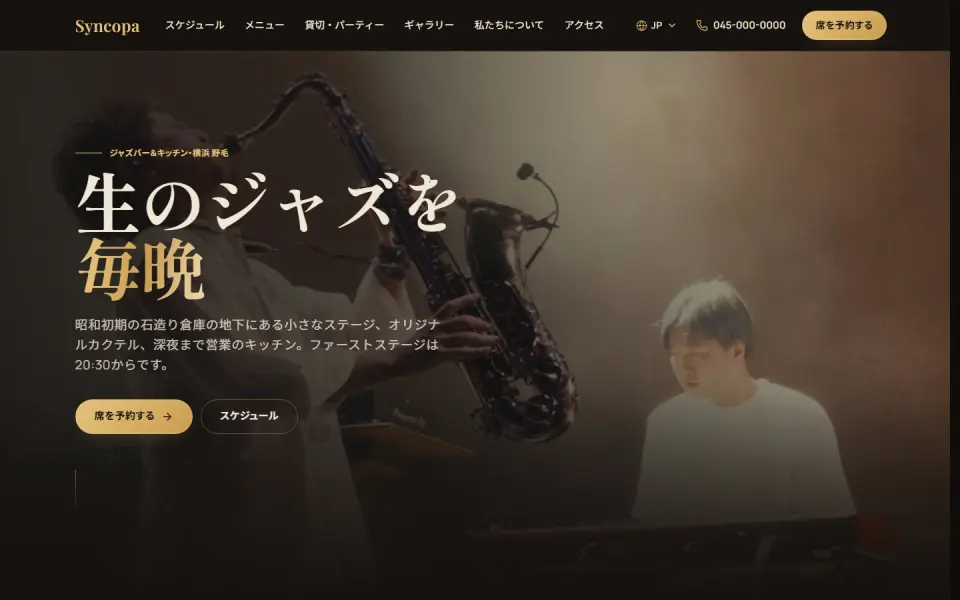 Jazz bar – SyncopaLive schedule, menu and table booking
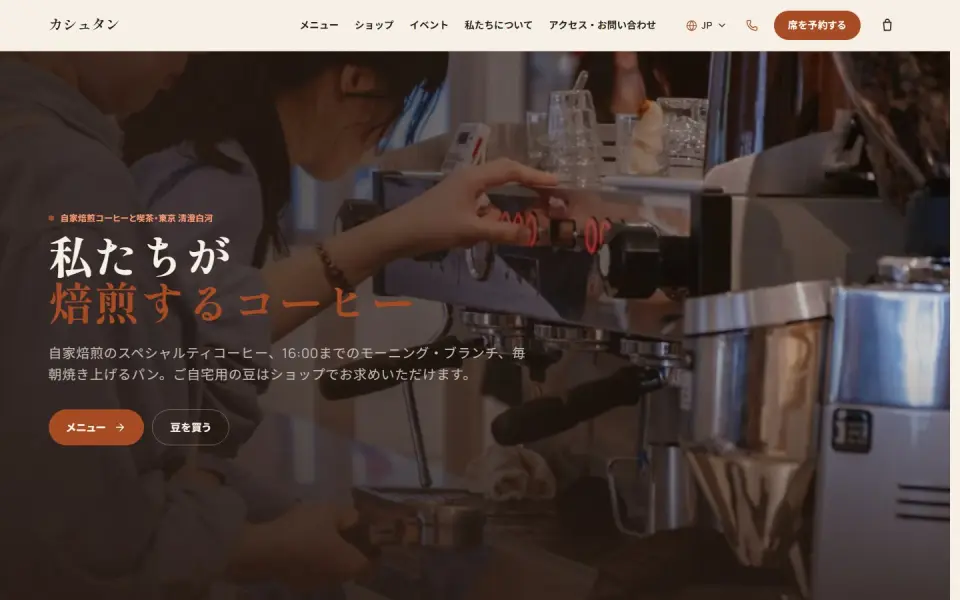 Café & roastery – KashtanMenu, events and an online bean shop
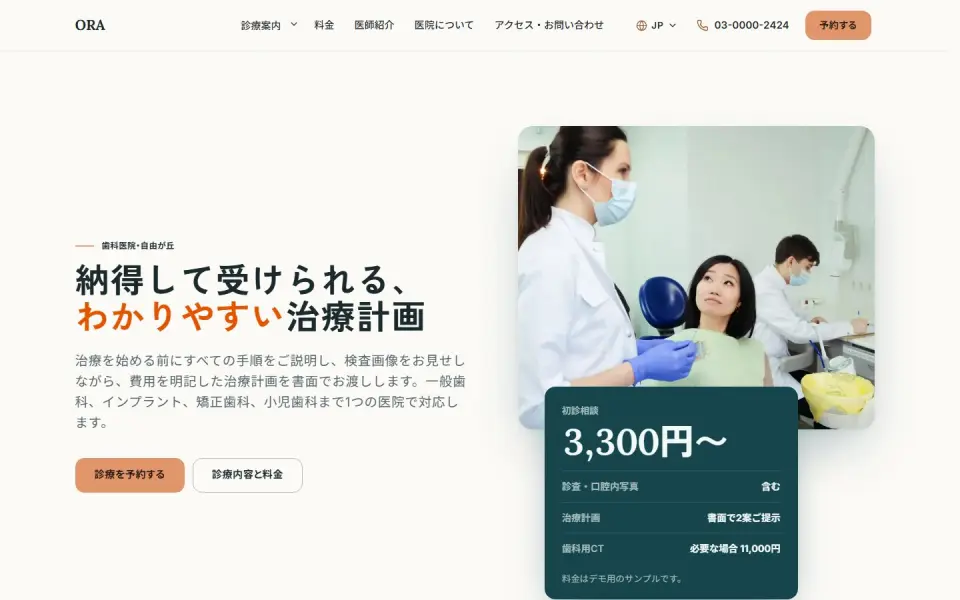 Dental clinic – ORATreatments, prices, doctors and booking
Template demos with fictional brands. Yours is built with your own brand and content.
How an English website project runs and what to prepare
When the Japanese site can serve as the source, a small English site of a few pages typically takes one to two months. The steps:
- Goal and reader: overseas sales, inbound visitors or recruiting – choose the action you want more of
- Structure: decide which pages carry over, which exist only in English and which are left out
- English copy: written from the key points of the Japanese text, with names and terms kept consistent
- Design and build: spacing and type set for English text length, checked on mobile
- Pre-launch checks: forms, the language switcher, page titles and descriptions for search
- After launch: see in GA4 which countries and pages perform, then refine
It helps to have ready: your Japanese site URL, any fixed English spellings of your company and product names, existing English brochures or catalogs, your target countries and the person who will answer English inquiries. To get found in English search, see English SEO.
We write the English from your Japanese content and you review it inside the free demo.
Site structure: add English pages or build a separate site
There are three common ways to set up an English site. The right one depends on how closely it follows your Japanese site and whether more languages may come later.
- English pages on the same domain (for example /en/): one site to manage and it benefits from your existing domain. The standard choice for most companies
- A separate English-only site: suits brands whose overseas products differ a lot from the domestic range, at the cost of running two sites
- A single English page: a quick start when you mainly need a URL to send to overseas partners; build it so it can grow
Whichever you choose, place the language switcher where people expect it and add hreflang tags so search engines know which pages belong together. If Chinese, Korean or other languages are on the roadmap, read about multilingual website development.
How UNANOBO builds English websites: a free demo first
Before you commit to anything, UNANOBO builds a free demo of your English site from your current Japanese site, materials and brand. The demo contains real English copy written for foreign readers, so you can open it on a computer and phone, read it as your customers would and decide once you are happy with how it comes across.
The process is simple: free demo, feedback, launch, growth. The founder works in both Japanese and English and handles every project personally, so your team can discuss intent in Japanese while the copy is finished in natural English. Everything runs by message. If you are an overseas company that needs a site for Japanese customers, see websites for entering the Japanese market.
How it works
- 01
Free demo
We start with a free demo built around your brand.
- 02
Feedback
Structure, tone and details are refined with you, on the demo itself.
- 03
Launch
The site goes live on a solid SEO foundation.
- 04
Growth
SEO and ads take it further, guided by the numbers.
FAQ
Does the free demo include English copy?
Yes. Based on your Japanese site or materials, we build a working English site centered on the home page, with real English text in place. You can check it on mobile too, and you decide whether to continue after seeing it.
What if we see the demo and decide not to go ahead?
That is fine. The demo is free, and stopping costs nothing. If something did not feel right, your feedback is welcome, but there is no obligation.
Our team is not confident in English. Can we still review the content?
Yes. You can communicate entirely in Japanese. Each page of English copy comes with a short Japanese note explaining what it says, so you can confirm the message matches your intent.
How long does it take to launch an English site?
A few pages built from existing Japanese content typically take one to two months. Sites with many new pages or a large online store take longer. You get an exact timeline with the plan and estimate after the demo.
Can we add English pages without changing our Japanese site?
Yes. We can add English pages such as /en/ to your current setup or build a separate English site, depending on how you update the site and what you plan next. Your domain and analytics accounts stay in your name.
Can we work with colleagues based overseas?
Yes. All communication is by message, so time zones are not a problem. Colleagues in Japan can write in Japanese and those abroad in English, through the same single contact.
Related pages
FREE DEMO
See your English website first
Send us your Japanese site's URL and we will build a free demo of your English site with natural English copy. Decide after you have seen it.