
Website translation from Japanese to English – a real English version of your site
More businesses in Japan want their website to work for international visitors, foreign residents and overseas partners. A translate button alone usually produces awkward English that barely shows up in search. This page explains how to turn your Japanese site into a proper English version, where auto-translate tools fall short, and what to prepare before you hire someone.
- Free demo – decide after you see it
- By message, in Japanese or English
- One person from demo to launch
FREE DEMO
See your site's English version – free
Send us your current site address. We build a free demo of the English version with your own content and brand, so you can judge the English before you decide.
- Your content as natural English pages
- Check the English version on phone and PC
- A suggested scope of pages to translate
Two ways to translate a Japanese website
There are two basic approaches to website translation from Japanese to English. The choice affects how your business comes across and whether English speakers can find you in search.
- Show machine translation on the fly: add a translate button or plugin that converts the page when someone views it. Quick and cheap to set up
- Build an English version: publish translated and edited pages under their own address, such as /en/. You control every sentence, and the pages can appear in English search results
Machine translation is fine for internal documents or pages where a rough idea is enough. For a site that should bring inquiries, bookings or sales, a real English version is the safer choice. If you are starting from scratch, see English website development.
The limits of Google Translate and other widgets
"Just add Google Translate" sounds like an easy fix, but in practice it runs into the same problems again and again. Google has also stopped offering its website translator widget to new sites.
- Context gets lost: Japanese often drops the subject and relies on polite forms and industry terms, so meaning shifts. Shop and product names sometimes get translated literally
- Search engines rarely index it: text translated in the browser does not exist as an English page that Google can list
- Text in images stays Japanese: menus, price tables and banners made as images are skipped entirely
- You cannot fix mistakes: errors stay on the page, and the output can change from one visit to the next
- Trust drops: clumsy English makes prices, booking rules and other key facts look unreliable
Visitors can already translate any page in their own browser. What your site can add is a clear, readable English version that covers what automatic tools get wrong. A quick test: open your main pages with browser translation to English and note where the message breaks down.
Send us your site address and we will show you a free demo of a properly edited English version.
Which pages to translate first
You rarely need to translate every page. Focus on what English readers actually look for and you save budget, launch sooner and keep the English side easy to maintain.
- Home page: who you are, what you offer and who it is for, at a glance
- Key service or product pages: your main offers, with prices, duration and other facts people need to decide
- Access and hours: the address in English format, directions from the nearest station, a map and closing days
- Booking and contact: a form that accepts English, the language you reply in, the channels you support
- FAQ: payment methods, cancellations, whether staff speak English and other common sticking points
- Terms: for online stores, shipping, returns and the legally required seller information in English
News and blog posts can stay Japanese-only at first; add them once you see demand. If more languages are on the roadmap, our guide to multilingual website development covers language choice and site structure.
What the free demo gives you
- 01A working demoA demo site you can open and click through on a computer and a phone.
- 02A structure proposalWhich pages you need, what goes on each and where visitors get in touch.
- 03Plan and estimateAfter you have seen the demo you get the plan to launch and an estimate.
Why it is safe to ask
- The demo is free. If you decide not to go ahead, it costs you nothing.
- Everything happens by message, in Japanese or English.
- Your domain, hosting, ad and analytics accounts stay in your name.
- The founder handles your project from the first demo to growth after launch – one contact all the way.
Demo sites we built
 Café & roastery – KashtanMenu, events and an online bean shop
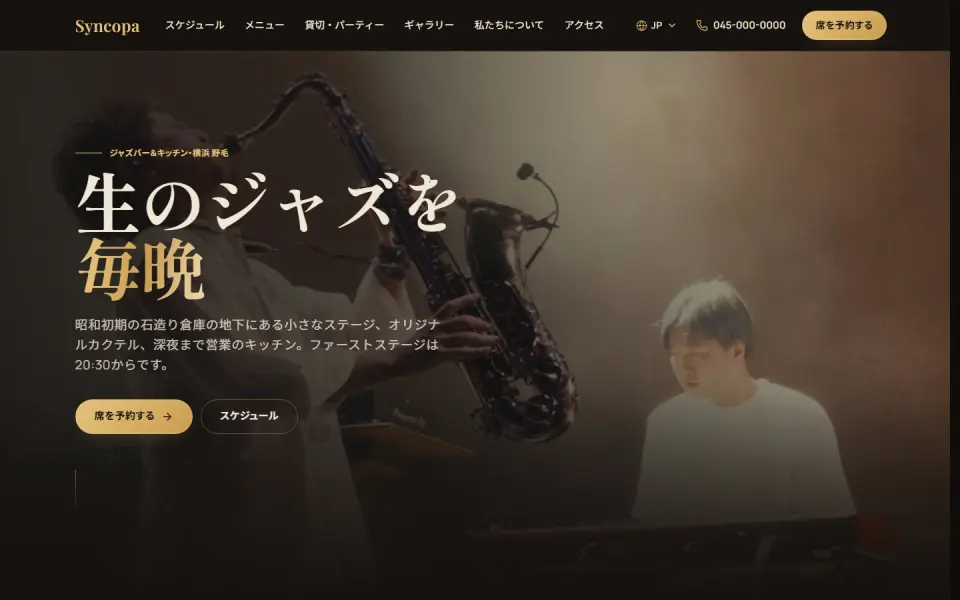 Jazz bar – SyncopaLive schedule, menu and table booking
 Beauty salon – MIRTABooking form, price list and team
Template demos with fictional brands. Yours is built with your own brand and content.
How to get natural English, step by step
Good web translation means an English reader gets the same message, with the same tone, as a Japanese reader. These steps keep the result consistent:
- Build a glossary: fix the English spelling of your company, shop, product and service names first and use it everywhere
- Know the reader: tourists, foreign residents in Japan and overseas buyers need different wording
- Translate, then rewrite: treat the first translation as a draft and reshape it into natural English order and length
- Explain Japanese conventions: reservation-only, tax-included prices, cover charges – add a short note where a foreigner would be confused
- Use English formats: address order, +81 phone numbers, dates, currency and opening hours
- Get a native read: before launch, have a native English speaker read the pages and flag anything that sounds off
Recreate image-based text for the English version or replace it with real text, which also makes later edits easier. Keep the glossary after launch – it pays off when you add pages or run ads in English.
We can settle the English names for your company and products together while reviewing the demo.
Checklist before you hire a translator or agency
Treat "translating the text" and "publishing English pages" as two separate jobs and quotes become much easier to compare. Translation agencies typically price by character count, while web studios usually quote per page.
- A list of pages to translate and a rough idea of how much text each one has
- The URL structure for English pages (for example a /en/ folder) and where the language switch sits
- Whether English page titles, meta descriptions and hreflang tags are included
- Who replies to English inquiries, and in which language
- How the English side gets updated when the Japanese site changes – in-house or by the provider
- Whether your CMS supports a second language (a multilingual plugin for WordPress, built-in language features in Shopify)
Getting found by English searchers also depends on English keywords and an English Google Business Profile – see English SEO for the details. Rankings are decided by search engines, so after launch the right move is to watch Search Console and adjust.
How UNANOBO handles website translation: a free demo of your English version
UNANOBO builds a free demo of the English version of your current site, based on your existing content and brand. You see the English copy, your names and address in English format and an English contact form on a working page, on your computer and phone. The English side can match your Japanese design, or become the starting point for a wider refresh.
The process is simple: free demo, feedback, launch, growth. The founder handles every project personally, from the first demo to English SEO and ads after launch, and everything runs by message in Japanese or English. That means you can discuss the nuance of a single phrase directly with the person writing it.
How it works
- 01
Free demo
We start with a free demo built around your brand.
- 02
Feedback
Structure, tone and details are refined with you, on the demo itself.
- 03
Launch
The site goes live on a solid SEO foundation.
- 04
Growth
SEO and ads take it further, guided by the numbers.
FAQ
How much does the free demo include?
A working English version of your site, centered on the home page and built from your current content. The text is edited to read as natural English. You decide whether to continue after seeing it.
Is there any cost if I do not go ahead?
No. The demo is free and you can say no after seeing it. If you continue, you get a proposal for which pages to translate, a plan and an estimate based on the demo.
Do I need to rewrite my Japanese copy for an English audience?
Not necessarily. We work from your current Japanese text and fill in what an English reader would miss. If there is information only the English side needs – English support, payment options – just let us know.
How long does it take to launch the English version?
It depends on the number of pages and whether image-based text needs to be redone. For a focused English version of a few key pages, a few weeks is typical. You get a schedule that matches the scope at the demo stage.
Can you add English pages without changing my current site?
In most cases, yes. We add English pages under an address such as /en/ and place a language switch next to the Japanese version. The best method depends on your CMS and how the site is built, so we suggest one after looking at your URL.
Can we work together entirely by message from overseas?
Yes. Planning, copy review and post-launch edits all run by message, in Japanese or English. We reply to inquiries within two business days.
Related pages
FREE DEMO
See your site in natural English first
Send us your current site's URL and we will build a free demo of its English version. Decide after you have read it.